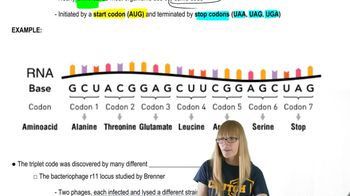
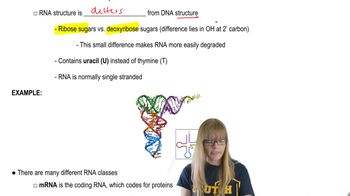
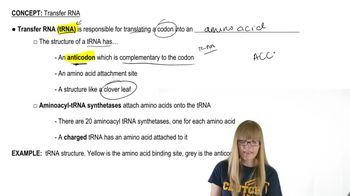
When the amino acid sequences of insulin isolated from different organisms were determined, differences were noted. For example, alanine was substituted for threonine, serine for glycine, and valine for isoleucine at corresponding positions in the protein. List the single-base changes that could occur in codons of the genetic code to produce these amino acid changes.

Refer to Table 13.1. Can you hypothesize why a synthetic RNA composed of a mixture of poly U poly A would not stimulate incorporation of ¹⁴C-phenylalanine into protein?
Verified step by step guidance
Verified video answer for a similar problem:
Key Concepts
Genetic Code and Codon Specificity
Role of Synthetic RNA in In Vitro Translation
Aminoacyl-tRNA Recognition and Codon-Anticodon Pairing
In studies of the amino acid sequence of wild-type and mutant forms of tryptophan synthetase in E. coli, the following changes have been observed:
Determine a set of triplet codes in which only a single-nucleotide change produces each amino acid change.
Why doesn't polynucleotide phosphorylase (Ochoa's enzyme) synthesize RNA in vivo?
Predict the amino acid sequence produced during translation by the following short hypothetical mRNA sequences (note that the second sequence was formed from the first by a deletion of only one nucleotide):
Sequence 1: 5'-AUGCCGGAUUAUAGUUGA-3'
Sequence 2: 5'-AUGCCGGAUUAAGUUGA-3'
What type of mutation gave rise to sequence 2?
A short RNA molecule was isolated that demonstrated a hyperchromic shift, indicating secondary structure. Its sequence was determined to be
5'-AGGCGCCGACUCUACU-3'
Propose a two-dimensional model for this molecule.
A short RNA molecule was isolated that demonstrated a hyperchromic shift, indicating secondary structure. Its sequence was determined to be
5'-AGGCGCCGACUCUACU-3'
What DNA sequence would give rise to this RNA molecule through transcription?
