Ch. 15 - Gene Mutation, DNA Repair, and Transposition
Klug - Concepts of Genetics  12th Edition
Klug12th EditionConcepts of Genetics ISBN: 9780135564776Not the one you use?Change textbook
Chapter 15, Problem 21

In maize, a Ds or Ac transposon can alter the function of genes at or near the site of transposon insertion. It is possible for these elements to transpose away from their original insertion site, causing a reversion of the mutant phenotype. In some cases, however, even more severe phenotypes appear, due to events at or near the mutant allele. What might be happening to the transposon or the nearby gene to create more severe mutations?

Verified step by step guidance
1
Understand that transposons like Ds (Dissociation) and Ac (Activator) can move within the genome, which can disrupt gene function when they insert into or near genes.
Recognize that when a transposon excises (moves out) from its original site, it can sometimes restore the gene's function, leading to a reversion of the mutant phenotype.
Consider that during the excision process, the transposon may not leave the DNA cleanly; it can cause small insertions or deletions (indels) at the excision site, which can further disrupt the gene.
Realize that these imprecise excision events can create more severe mutations if they alter the coding sequence or regulatory regions of the gene, potentially causing frameshifts or loss of important gene elements.
Also, transposon movement can cause chromosomal rearrangements or affect nearby genes, which might contribute to the appearance of more severe phenotypes.

Verified video answer for a similar problem:

This video solution was recommended by our tutors as helpful for the problem above.
Video duration:
51s
Was this helpful?

Key Concepts

Here are the essential concepts you must grasp in order to answer the question correctly.

Transposons and Their Mechanism of Transposition

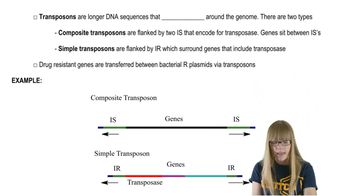
Transposons, such as Ds and Ac elements in maize, are DNA sequences that can move within the genome. They insert into genes or regulatory regions, disrupting normal gene function. Their movement can be cut-and-paste or replicative, causing mutations or reversions depending on insertion or excision events.
Recommended video:
Guided course
06:10
Prokaryotic Transposable Elements

Effects of Transposon Excision and Footprint Mutations

When a transposon excises from a gene, it may leave behind small insertions or deletions called footprints. These residual changes can alter the gene's coding sequence or regulatory elements, sometimes causing more severe mutations than the original insertion by disrupting gene function more extensively.
Recommended video:
Guided course
03:38
Maternal Effect

Local Genomic Instability Induced by Transposons

Transposon activity can induce genomic instability near the insertion site, including chromosomal rearrangements, duplications, or deletions. Such events can exacerbate mutant phenotypes by affecting multiple genes or regulatory regions, leading to more severe or novel mutations beyond simple insertional disruption.
Recommended video:
Guided course
04:29
Induced Mutations
Related Practice
Textbook Question

What genetic defects result in the disorder xeroderma pigmentosum (XP) in humans? How do these defects create the phenotypes associated with the disorder?

577
views
Textbook Question

Compare DNA transposons and retrotransposons. What properties do they share?

1224
views
Textbook Question

Speculate on how improved living conditions and medical care in the developed nations might affect human mutation rates, both neutral and deleterious.

536
views
Textbook Question

It is estimated that about 0.2 percent of human mutations are due to TE insertions, and a much higher degree of mutational damage is known to occur in some other organisms. In what way might a TE insertion contribute positively to evolution?

427
views
Textbook Question

In a bacterial culture in which all cells are unable to synthesize leucine (leu⁻), a potent mutagen is added, and the cells are allowed to undergo one round of replication. At that point, samples are taken, a series of dilutions are made, and the cells are plated on either minimal medium or minimal medium containing leucine. The first culture condition (minimal medium) allows the growth of only leu⁺ cells, while the second culture condition (minimal medium with leucine added) allows growth of all cells. The results of the experiment are as follows:

What is the rate of mutation at the locus associated with leucine biosynthesis?

687
views
Textbook Question

Presented here are hypothetical findings from studies of heterokaryons formed from seven human xeroderma pigmentosum cell strains:

These data are measurements of the occurrence or nonoccurrence of unscheduled DNA synthesis in the fused heterokaryon. None of the strains alone shows any unscheduled DNA synthesis. Which strains fall into the same complementation groups? How many different groups are revealed based on these data? What can we conclude about the genetic basis of XP from these data?

588
views