In this chapter, we focused on the regulation of gene expression in bacteria. Along the way, we found many opportunities to consider the methods and reasoning by which much of this information was acquired. From the explanations given in the chapter, what answers would you propose to the following fundamental questions? How do we know that bacteria regulate the expression of certain genes in response to the environment?
Ch. 16 - Regulation of Gene Expression in Bacteria

Chapter 16, Problem 1c
What led researchers to conclude that a repressor molecule regulates the lac operon?
Verified step by step guidance1
Understand the lac operon system: It is a set of genes involved in lactose metabolism in bacteria, regulated to be active only when lactose is present and glucose is absent.
Recognize the role of gene expression regulation: Researchers observed that the lac operon genes are not always expressed, suggesting the presence of a regulatory mechanism controlling transcription.
Examine experimental evidence: Scientists performed experiments where they added or removed lactose and observed changes in enzyme production, indicating that something was inhibiting gene expression in the absence of lactose.
Identify the repressor hypothesis: The idea emerged that a molecule (the repressor) binds to the operator region of the lac operon to block RNA polymerase and prevent transcription when lactose is absent.
Confirm through mutations and binding studies: Mutations in the operator or repressor gene led to continuous expression of the operon, supporting the conclusion that a repressor molecule regulates the lac operon by binding to the operator and controlling gene expression.

Verified video answer for a similar problem:
This video solution was recommended by our tutors as helpful for the problem above.
Video duration:
26sWas this helpful?
Key Concepts
Here are the essential concepts you must grasp in order to answer the question correctly.
Lac Operon Structure and Function
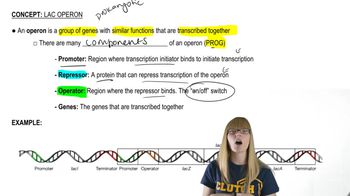
The lac operon is a set of genes in E. coli responsible for metabolizing lactose. It includes structural genes, a promoter, an operator, and regulatory elements. Understanding its components is essential to grasp how gene expression is controlled in response to environmental lactose.
Recommended video:
Guided course
Lac Operon Overview
Role of the Repressor Protein
The repressor is a protein that binds to the operator region of the lac operon, blocking RNA polymerase and preventing transcription when lactose is absent. This negative regulation ensures the operon is only active when lactose is available, conserving cellular resources.
Recommended video:
Guided course
Proteins
Experimental Evidence for Repression
Researchers used genetic mutations and biochemical assays to show that mutations in the operator or repressor gene altered lac operon expression. These experiments demonstrated that a diffusible repressor molecule binds the operator to regulate gene activity, leading to the conclusion of repressor-mediated control.
Recommended video:
Guided course
Transformation
Related Practice
Textbook Question
670
views
Textbook Question
What evidence established that lactose serves as the inducer of a gene whose product is related to lactose metabolism?
659
views
Textbook Question
How do we know that the lac repressor is a protein?
523
views
Textbook Question
How do we know that the trp operon is a repressible control system, in contrast to the lac operon, which is an inducible control system?
733
views
Textbook Question
Write a brief essay that discusses why you think regulatory systems evolved in bacteria (i.e., what advantages do regulatory systems provide to these organisms?), and, in the context of regulation, discuss why genes related to common functions are found together in operons.
427
views