The Human Genome Project has demonstrated that in humans of all races and nationalities approximately 99.9 percent of the genome sequence is the same, yet different individuals can be identified by DNA fingerprinting techniques. What is one primary variation in the human genome that can be used to distinguish different individuals? Briefly explain your answer.

Describe the significance of the Genome 10K project.
Verified step by step guidance
Verified video answer for a similar problem:
Key Concepts
Genome 10K Project Overview
Comparative Genomics
Applications in Conservation Biology
Through the Human Genome Project (HGP), a relatively accurate human genome sequence was published from combined samples from multiple individuals. It serves as a reference for a haploid genome. How do results from personal genome projects (PGP) differ from those of the HGP?
Explain differences between whole-genome sequencing (WGS) and whole-exome sequencing (WES), and describe advantages and disadvantages of each approach for identifying disease-causing mutations in a genome. Which approach was used for the Human Genome Project?
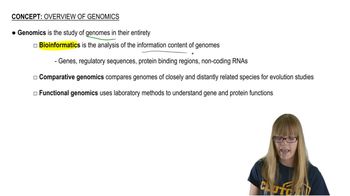
It can be said that modern biology is experiencing an 'omics' revolution. What does this mean? Explain your answer.
Metagenomics studies generate very large amounts of sequence data. Provide examples of genetic insight that can be learned from metagenomics.
What are DNA microarrays? How are they used?
