Pearson+ LogoPearson+ Logo
Ch. 21 - Genomic Analysis
Klug - Concepts of Genetics  12th Edition
Klug12th EditionConcepts of Genetics ISBN: 9780135564776Not the one you use?Change textbook
Chapter 21, Problem 16

It can be said that modern biology is experiencing an 'omics' revolution. What does this mean? Explain your answer.

Verified step by step guidance
1
Understand that the term 'omics' refers to a broad field of study in biology that involves comprehensive analysis of various types of biological molecules, such as genes, proteins, and metabolites.
Recognize that the 'omics' revolution means the shift from studying individual genes or proteins to analyzing entire sets or systems, such as the genome (all genes), proteome (all proteins), or metabolome (all metabolites) of an organism.
Explain that this revolution is driven by advances in high-throughput technologies and computational methods that allow scientists to collect and analyze large-scale biological data efficiently.
Highlight that the 'omics' approach enables a more holistic understanding of biological processes, interactions, and functions at a system-wide level rather than isolated components.
Conclude that the 'omics' revolution is transforming biology by providing deeper insights into complex biological systems, disease mechanisms, and personalized medicine.

Verified video answer for a similar problem:

This video solution was recommended by our tutors as helpful for the problem above.
Video duration:
2m
Was this helpful?

Key Concepts

Here are the essential concepts you must grasp in order to answer the question correctly.

Omics Technologies

Omics refers to comprehensive approaches in biology that analyze entire sets of molecules, such as genomes (genomics), proteins (proteomics), or metabolites (metabolomics). These technologies enable large-scale data collection to understand biological systems holistically rather than focusing on individual components.
Recommended video:
Guided course
09:03
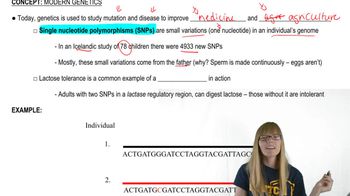
Modern Genetics

High-Throughput Data Generation

High-throughput techniques allow rapid and simultaneous analysis of thousands to millions of biological molecules. This capability drives the 'omics' revolution by producing vast datasets that reveal complex interactions and functions within cells and organisms.
Recommended video:
Guided course
03:39
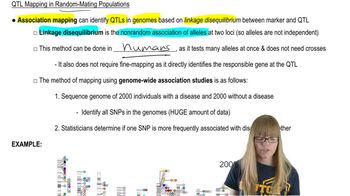
QTL Mapping in Humans

Systems Biology

Systems biology integrates omics data to model and understand the dynamic interactions within biological systems. It shifts biology from studying isolated parts to analyzing networks and pathways, providing insights into how molecular components work together to influence health and disease.
Recommended video:
Guided course
04:24
Sex Determination