Pearson+ LogoPearson+ Logo
Ch. 21 - Genomic Analysis
Klug - Concepts of Genetics  12th Edition
Klug12th EditionConcepts of Genetics ISBN: 9780135564776Not the one you use?Change textbook
Chapter 21, Problem 1a

How do we know which contigs are part of the same chromosome?

Verified step by step guidance
1
Understand that contigs are continuous sequences of DNA assembled from overlapping reads, but they do not inherently indicate their position on chromosomes.
Use paired-end or mate-pair sequencing data, where pairs of reads are known to be a certain distance apart; if pairs map to different contigs, this suggests those contigs are physically close on the same chromosome.
Apply genetic linkage information or physical mapping techniques such as fluorescence in situ hybridization (FISH) to associate contigs with specific chromosomes.
Utilize long-range sequencing technologies or scaffolding methods that link contigs based on known distances or chromatin conformation capture data (e.g., Hi-C) to group contigs into chromosome-scale assemblies.
Integrate all these data sources to build scaffolds and assign contigs to chromosomes by analyzing consistent linkage, proximity, and mapping evidence.

Verified video answer for a similar problem:

This video solution was recommended by our tutors as helpful for the problem above.
Video duration:
1m
Was this helpful?

Key Concepts

Here are the essential concepts you must grasp in order to answer the question correctly.

Contigs and Genome Assembly

Contigs are continuous sequences of DNA assembled from overlapping short reads during genome sequencing. Understanding how contigs are formed helps in piecing together the genome, but contigs alone do not indicate their chromosomal origin without further analysis.
Recommended video:
Guided course
02:48
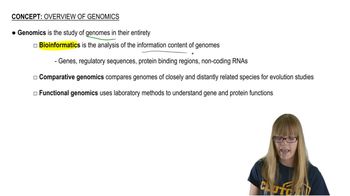
Genomics Overview

Physical and Genetic Mapping

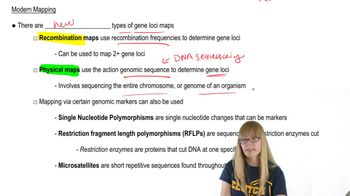
Physical mapping uses techniques like fluorescence in situ hybridization (FISH) or optical mapping to locate contigs on chromosomes, while genetic mapping relies on recombination frequencies between markers. Both methods help assign contigs to specific chromosomes by providing positional information.
Recommended video:
Guided course
03:04
Modern Mapping

Paired-End and Mate-Pair Sequencing

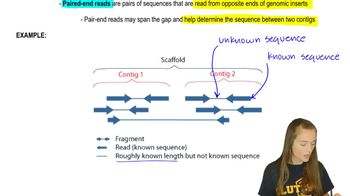
Paired-end and mate-pair sequencing generate reads from both ends of DNA fragments of known size, linking contigs that are physically close on the same chromosome. This linkage information is crucial for ordering contigs and determining their chromosomal association.
Recommended video:
Guided course
08:41
Sequencing Difficulties