Pearson+ LogoPearson+ Logo
Ch. 23 - Developmental Genetics
Klug - Concepts of Genetics  12th Edition
Klug12th EditionConcepts of Genetics ISBN: 9780135564776Not the one you use?Change textbook
Chapter 23, Problem 1a

In the discussion, we have focused on large-scale as well as the inter- and intracellular events that take place during embryogenesis and the formation of adult structures. In particular, we discussed how the adult body plan is laid down by a cascade of gene expression, and the role of cell–cell communication in development. Based on your knowledge of these topics, answer several fundamental questions:
How have we discovered that specific genes control development in an organism like Drosophila?

Verified step by step guidance
1
Understand that the discovery of specific genes controlling development in Drosophila (fruit flies) was made possible through genetic screens, which involve inducing mutations and observing their effects on development.
Recognize that researchers used mutagenesis to create random mutations in the Drosophila genome and then screened for phenotypic changes in embryonic or adult structures.
Learn that the identification of mutants with developmental defects allowed scientists to pinpoint genes essential for specific developmental processes, such as segmentation or body patterning.
Understand that molecular techniques, such as cloning and sequencing, were used to identify and characterize the genes responsible for the observed phenotypes.
Appreciate that further experiments, such as in situ hybridization or reporter gene assays, were used to study the spatial and temporal expression patterns of these genes, revealing their roles in the gene expression cascade and cell–cell communication during development.

Verified video answer for a similar problem:

This video solution was recommended by our tutors as helpful for the problem above.
Video duration:
2m
Was this helpful?

Key Concepts

Here are the essential concepts you must grasp in order to answer the question correctly.

Gene Expression in Development

Gene expression refers to the process by which specific genes are activated to produce their corresponding proteins, which play crucial roles in cellular functions and development. In embryogenesis, precise timing and regulation of gene expression are essential for the proper formation of tissues and organs, as different genes are turned on or off in response to developmental cues.
Recommended video:
Guided course
02:09
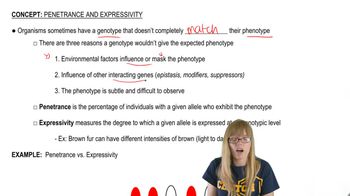
Penetrance and Expressivity

Drosophila as a Model Organism

Drosophila melanogaster, commonly known as the fruit fly, is a widely used model organism in genetics due to its short life cycle, well-mapped genome, and the ease of genetic manipulation. Studies in Drosophila have provided significant insights into the genetic control of development, allowing researchers to identify specific genes that regulate processes such as segmentation and body patterning.
Recommended video:
Guided course
03:08
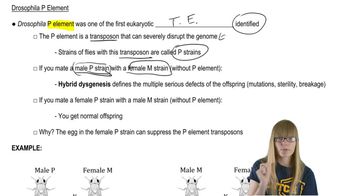
Drosophila P Element

Cell-Cell Communication in Development

Cell-cell communication is vital during embryogenesis, as it allows cells to coordinate their activities and respond to signals from neighboring cells. This communication often involves signaling pathways that influence gene expression, guiding cells to differentiate into specific types and organize into functional structures, ultimately shaping the organism's body plan.
Recommended video:
Guided course
03:52
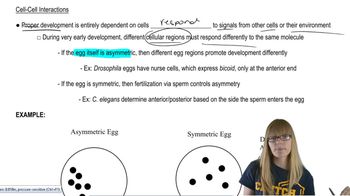
Cell-cell interactions
Related Practice
Textbook Question

In the discussion, we have focused on large-scale as well as the inter- and intracellular events that take place during embryogenesis and the formation of adult structures. In particular, we discussed how the adult body plan is laid down by a cascade of gene expression, and the role of cell–cell communication in development. Based on your knowledge of these topics, answer several fundamental questions:

How do we know that molecular gradients in the egg of Drosophila exist?

423
views
Textbook Question

In the discussion, we have focused on large-scale as well as the inter- and intracellular events that take place during embryogenesis and the formation of adult structures. In particular, we discussed how the adult body plan is laid down by a cascade of gene expression, and the role of cell–cell communication in development. Based on your knowledge of these topics, answer several fundamental questions:

How did we discover that selector genes specify which adult structures will be formed by body segments?

370
views
Textbook Question

In the discussion, we have focused on large-scale as well as the inter- and intracellular events that take place during embryogenesis and the formation of adult structures. In particular, we discussed how the adult body plan is laid down by a cascade of gene expression, and the role of cell–cell communication in development. Based on your knowledge of these topics, answer several fundamental questions:

How did we learn about the levels of gene regulation involved in vulval development in C. elegans?

434
views