Pearson+ LogoPearson+ Logo
Ch. 3 - Mendelian Genetics
Klug - Concepts of Genetics  12th Edition
Klug12th EditionConcepts of Genetics ISBN: 9780135564776Not the one you use?Change textbook
Chapter 3, Problem 22d

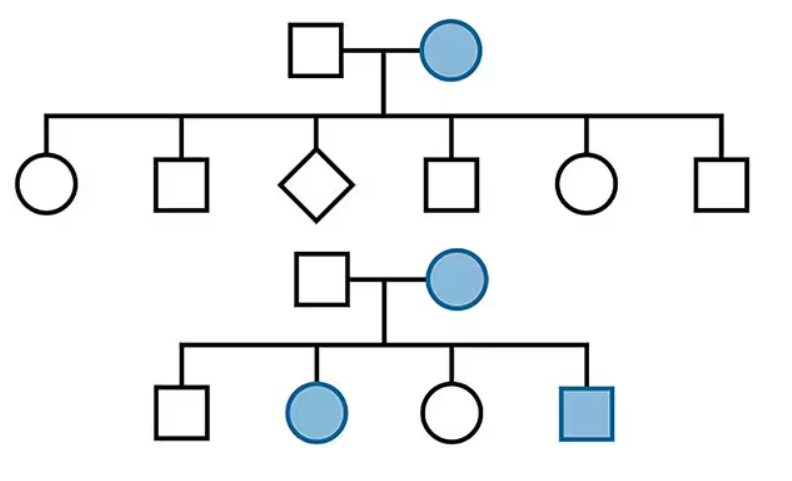
Draw all possible conclusions concerning the mode of inheritance of the trait portrayed in the following limited pedigree.
Pedigree chart showing affected females and males across two generations with some individuals shaded blue.

Verified step by step guidance
1
Examine the pedigree chart to identify affected individuals (shaded squares or circles) and unaffected individuals (unshaded squares or circles). Note the pattern of inheritance across generations.
Determine whether the trait skips generations. If it does, this suggests a recessive mode of inheritance. If it does not, it may indicate a dominant mode of inheritance.
Analyze the gender of affected individuals. If the trait appears predominantly in one gender, it may suggest sex-linked inheritance. If both genders are equally affected, it is likely autosomal.
Check if affected individuals have unaffected parents. If this occurs, it supports a recessive inheritance pattern. If affected individuals have at least one affected parent, it supports a dominant inheritance pattern.
Consider the possibility of X-linked inheritance by observing if affected males pass the trait to their daughters but not their sons, or if affected females pass the trait to both sons and daughters. If no such pattern is observed, the trait is likely autosomal.

Verified video answer for a similar problem:

This video solution was recommended by our tutors as helpful for the problem above.
Video duration:
49s
Was this helpful?

Key Concepts

Here are the essential concepts you must grasp in order to answer the question correctly.

Pedigree Analysis

Pedigree analysis is a method used to trace the inheritance patterns of traits through generations in a family. It involves constructing a family tree that illustrates the relationships between individuals and the presence or absence of specific traits. By analyzing the pedigree, geneticists can infer whether a trait is dominant, recessive, or linked to sex chromosomes, aiding in understanding genetic disorders and inheritance patterns.
Recommended video:
Guided course
01:59
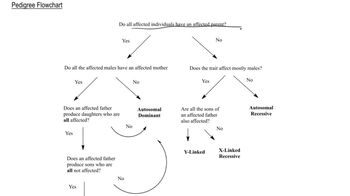
Pedigree Flowchart

Modes of Inheritance

Modes of inheritance refer to the patterns by which traits and genetic conditions are passed from parents to offspring. The primary modes include autosomal dominant, autosomal recessive, X-linked dominant, and X-linked recessive. Understanding these modes helps in predicting the likelihood of offspring inheriting specific traits based on parental genotypes and phenotypes, which is crucial for genetic counseling and research.
Recommended video:
Guided course
05:13
Organelle Inheritance

Genotype vs. Phenotype

Genotype refers to the genetic makeup of an individual, including all alleles present, while phenotype is the observable expression of those genes, influenced by both genotype and environmental factors. In pedigree analysis, distinguishing between genotype and phenotype is essential for determining inheritance patterns, as phenotypic traits can reveal underlying genotypic information, especially when analyzing dominant and recessive traits.
Recommended video:
Guided course
07:52
Gamete Genotypes
Related Practice
Textbook Question

Draw all possible conclusions concerning the mode of inheritance of the trait portrayed in the following limited pedigree.

1084
views
Textbook Question

Draw all possible conclusions concerning the mode of inheritance of the trait portrayed in the following limited pedigree.

1091
views
Textbook Question

Draw all possible conclusions concerning the mode of inheritance of the trait portrayed in the following limited pedigree.

614
views
Textbook Question
For decades scientists have been perplexed by different circumstances surrounding families with rare, early-onset auditory neuropathy (deafness). In some families, parents and grandparents of the proband have normal hearing, while in other families, a number of affected (deaf) family members are scattered throughout the pedigree, appearing in every generation. Assuming a genetic cause for each case, offer a reasonable explanation for the genetic origin of such deafness in the two types of families.
566
views
Textbook Question

A 'wrongful birth' case was recently brought before a court in which a child with Smith–Lemli–Opitz syndrome was born to apparently healthy parents. This syndrome is characterized by a cluster of birth defects including cleft palate, and an array of problems with the reproductive and urinary organs. Originally considered by their physician as having a nongenetic basis, the parents decided to have another child, who was also born with Smith–Lemli–Opitz syndrome. In the role of a genetic counselor, instruct the court about what occurred, including the probability of the parents having two affected offspring, knowing that the disorder is inherited as a recessive trait.

494
views
Textbook Question

A 'wrongful birth' case was recently brought before a court in which a child with Smith–Lemli–Opitz syndrome was born to apparently healthy parents. This syndrome is characterized by a cluster of birth defects including cleft palate, and an array of problems with the reproductive and urinary organs. Originally considered by their physician as having a nongenetic basis, the parents decided to have another child, who was also born with Smith–Lemli–Opitz syndrome. In the role of a genetic counselor, instruct the court about what occurred, including the probability of the parents having two affected offspring, knowing that the disorder is inherited as a recessive trait. Draw a pedigree of the families of this couple, showing the relevant individuals.

719
views