Pearson+ LogoPearson+ Logo
Ch. 4 - Extensions of Mendelian Genetics
Klug - Concepts of Genetics  12th Edition
Klug12th EditionConcepts of Genetics ISBN: 9780135564776Not the one you use?Change textbook
Chapter 4, Problem 1d

The discussion centers on extensions and modifications of Mendelian principles and ratios. In the process, we encountered many opportunities to consider how this information was acquired. On the basis of these discussions, what answers would you propose to the following fundamental questions?
For genes whose expression seems to be tied to the sex of individuals, how do we know whether a gene is X-linked in contrast to exhibiting sex-limited or sex-influenced inheritance?

Verified step by step guidance
1
Step 1: Understand the definitions of the three inheritance patterns: X-linked inheritance involves genes located on the X chromosome; sex-limited inheritance refers to traits expressed only in one sex despite the gene being present in both; sex-influenced inheritance means the trait expression differs between sexes due to hormonal or physiological differences.
Step 2: Examine the pedigree patterns for clues: In X-linked inheritance, affected males often have carrier or affected mothers, and the trait typically shows different transmission patterns between males and females, such as no male-to-male transmission.
Step 3: For sex-limited traits, observe if the trait appears exclusively in one sex even though both sexes carry the gene, indicating that expression is restricted by sex-specific factors rather than chromosome location.
Step 4: For sex-influenced traits, look for differences in trait expression or penetrance between males and females, where the gene is autosomal but the phenotype is more common or severe in one sex due to hormonal influence.
Step 5: Use molecular or genetic testing to confirm gene location (e.g., linkage analysis or sequencing) and combine this with phenotypic data to distinguish X-linked inheritance from sex-limited or sex-influenced patterns.

Verified video answer for a similar problem:

This video solution was recommended by our tutors as helpful for the problem above.
Video duration:
1m
Was this helpful?

Key Concepts

Here are the essential concepts you must grasp in order to answer the question correctly.

X-linked Inheritance

X-linked inheritance refers to genes located on the X chromosome, which show distinct patterns of transmission and expression between males and females due to their differing sex chromosome compositions. Males (XY) express X-linked traits with only one allele, while females (XX) may be carriers or express the trait depending on dominance. Pedigree analysis often reveals characteristic inheritance patterns, such as affected males with carrier mothers.
Recommended video:
Guided course
09:30
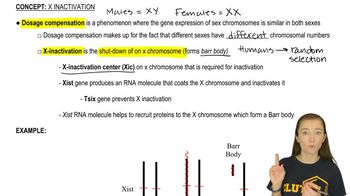
X-Inactivation

Sex-limited Inheritance

Sex-limited inheritance involves genes present in both sexes but expressed only in one sex due to physiological or hormonal differences, such as genes controlling milk production in female mammals. These traits do not follow typical Mendelian ratios because expression is restricted to one sex, despite both sexes carrying the gene.
Recommended video:
Guided course
07:56
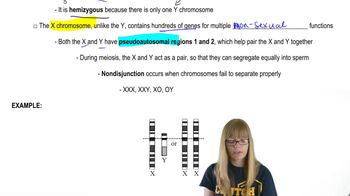
Sex-Linked Genes

Sex-influenced Inheritance

Sex-influenced inheritance describes traits where gene expression differs between sexes, often due to hormonal effects, causing a dominant allele in one sex to be recessive in the other. For example, a gene may cause baldness dominantly in males but recessively in females, leading to different phenotypic ratios in males and females despite the gene being autosomal.
Recommended video:
Guided course
07:56
Sex-Linked Genes
Related Practice
Textbook Question

How were early geneticists able to ascertain inheritance patterns that did not fit typical Mendelian ratios?

522
views
Textbook Question

In the discussion, we focused on extensions and modifications of Mendelian principles and ratios. In the process, we encountered many opportunities to consider how this information was acquired. On the basis of these discussions, what answers would you propose to the following fundamental questions?

How did geneticists determine that inheritance of some phenotypic characteristics involves the interactions of two or more gene pairs? How were they able to determine how many gene pairs were involved?

722
views
Textbook Question

The discussion centers on extensions and modifications of Mendelian principles and ratios. In the process, we encountered many opportunities to consider how this information was acquired. On the basis of these discussions, what answers would you propose to the following fundamental questions?

How do we know that specific genes are located on the sex-determining chromosomes rather than on autosomes?

446
views
Textbook Question
Write a short essay that explains why multiple and lethal alleles often result in a modification of the classic Mendelian monohybrid and dihybrid ratios.
456
views
Textbook Question

In shorthorn cattle, coat color may be red, white, or roan. Roan is an intermediate phenotype expressed as a mixture of red and white hairs. The following data were obtained from various crosses:

How is coat color inherited? What are the genotypes of parents and offspring for each cross?

1512
views
Textbook Question

In foxes, two alleles of a single gene, P and p, may result in lethality (PP), platinum coat (Pp), or silver coat (pp). What ratio is obtained when platinum foxes are interbred? Is the P allele behaving dominantly or recessively in causing (a) lethality; (b) platinum coat color?

993
views