Pearson+ LogoPearson+ Logo
Ch. 4 - Extensions of Mendelian Genetics
Klug - Concepts of Genetics  12th Edition
Klug12th EditionConcepts of Genetics ISBN: 9780135564776Not the one you use?Change textbook
Chapter 4, Problem 1a

How were early geneticists able to ascertain inheritance patterns that did not fit typical Mendelian ratios?

Verified step by step guidance
1
Early geneticists observed inheritance patterns that deviated from Mendelian ratios by conducting controlled breeding experiments and analyzing the resulting phenotypic ratios in offspring. They noticed that some traits did not follow the expected 3:1 or 9:3:3:1 ratios predicted by Mendel's laws.
They hypothesized that factors such as incomplete dominance, codominance, multiple alleles, and gene interactions (epistasis) could influence inheritance patterns. For example, in incomplete dominance, heterozygotes exhibit an intermediate phenotype rather than a dominant one.
Geneticists also considered the possibility of linkage, where genes located close together on the same chromosome are inherited together, disrupting the independent assortment principle. They used test crosses and recombination frequency data to map gene locations.
They studied sex-linked traits, where genes located on sex chromosomes (e.g., X-linked traits) showed inheritance patterns that differed between males and females. This was particularly evident in traits like color blindness and hemophilia in humans.
Finally, they incorporated environmental influences and pleiotropy (one gene affecting multiple traits) into their analyses, recognizing that not all phenotypic variations could be explained solely by Mendelian genetics. These observations led to the development of more comprehensive models of inheritance.

Verified video answer for a similar problem:

This video solution was recommended by our tutors as helpful for the problem above.
Video duration:
1m
Was this helpful?

Key Concepts

Here are the essential concepts you must grasp in order to answer the question correctly.

Mendelian Genetics

Mendelian genetics is the study of how traits are inherited through generations based on the principles established by Gregor Mendel. His experiments with pea plants led to the formulation of key concepts such as dominant and recessive alleles, as well as the laws of segregation and independent assortment. These principles provide a foundational understanding of inheritance patterns, which serve as a baseline for identifying deviations in genetic ratios.
Recommended video:
Guided course
03:45
Descriptive Genetics

Non-Mendelian Inheritance

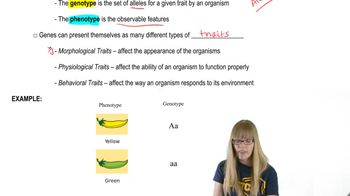
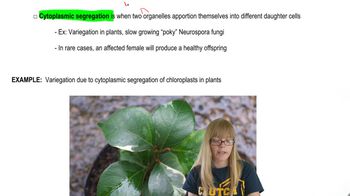
Non-Mendelian inheritance refers to patterns of inheritance that do not follow Mendel's laws. This includes phenomena such as incomplete dominance, codominance, and polygenic inheritance, where multiple genes influence a trait. Understanding these patterns is crucial for early geneticists as they observed traits that did not conform to expected Mendelian ratios, prompting further investigation into the complexities of genetic inheritance.
Recommended video:
Guided course
05:13
Organelle Inheritance

Quantitative Genetics

Quantitative genetics is the study of traits that are influenced by multiple genes and environmental factors, leading to continuous variation in phenotypes. Early geneticists utilized statistical methods to analyze these traits, which often resulted in bell-shaped distributions rather than discrete categories. This approach allowed them to identify inheritance patterns that deviated from Mendelian expectations, thereby expanding the understanding of genetic complexity.
Recommended video:
Guided course
03:45
Descriptive Genetics