
Textbook Question
Why are double-crossover events expected less frequently than single-crossover events?
1466
views
1
rank

 Verified step by step guidance
 07:11
07:11
 05:19
05:19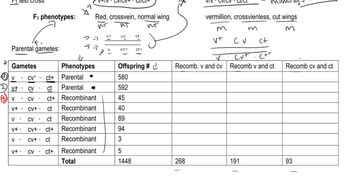 26:08
26:08Why are double-crossover events expected less frequently than single-crossover events?
In the cross shown here, involving two linked genes, ebony (e) and claret (ca), in Drosophila, where crossing over does not occur in males, offspring were produced in a 2 + : 1 ca : 1 e phenotypic ratio:
These genes are 30 units apart on chromosome III. What did crossing over in the female contribute to these phenotypes?
The genes dumpy (dp), clot (cl), and apterous (ap) are linked on chromosome II of Drosophila. In a series of two-point mapping crosses, the following genetic distances were determined. What is the sequence of the three genes?
dp–ap: 42
dp–cl: 3
ap–cl: 39
Explain why a 50 percent recovery of single-crossover products is the upper limit, even when crossing over always occurs between two linked genes?
Colored aleurone in the kernels of corn is due to the dominant allele R. The recessive allele r, when homozygous, produces colorless aleurone. The plant color (not the kernel color) is controlled by another gene with two alleles, Y and y. The dominant Y allele results in green color, whereas the homozygous presence of the recessive y allele causes the plant to appear yellow. In a testcross between a plant of unknown genotype and phenotype and a plant that is homozygous recessive for both traits, the following progeny were obtained:
colored, green: 88
colored, yellow: 12
colorless, green: 8
colorless, yellow: 92
Explain how these results were obtained by determining the exact genotype and phenotype of the unknown plant, including the precise arrangement of the alleles on the homologs.
What is the proposed basis for positive interference?