Pearson+ LogoPearson+ Logo
Ch. 8 - Chromosome Mutations: Variation in Number and Arrangement
Klug - Concepts of Genetics  12th Edition
Klug12th EditionConcepts of Genetics ISBN: 9780135564776Not the one you use?Change textbook
Chapter 8, Problem 29

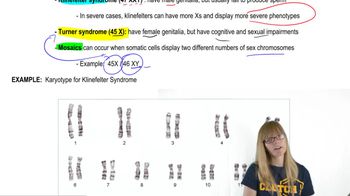
A 3-year-old child exhibited some early indication of Turner syndrome, which results from a 45,X chromosome composition. Karyotypic analysis demonstrated two cell types: 46,XX (normal) and 45,X. Propose a mechanism for the origin of this mosaicism.

Verified step by step guidance
1
Understand that Turner syndrome typically results from monosomy X (45,X), where one X chromosome is missing in all cells, but mosaicism means there are two or more different cell lines in the same individual.
Recognize that the presence of both 46,XX and 45,X cell lines suggests that the individual started from a single fertilized egg but developed two genetically distinct populations of cells.
Consider that the mosaicism could arise from a post-zygotic error, such as nondisjunction or anaphase lag, occurring during an early mitotic division after fertilization of a normal 46,XX zygote.
Specifically, anaphase lag could cause one X chromosome to be lost in some cells during mitosis, resulting in a 45,X cell line alongside the original 46,XX cells.
Summarize that the mechanism involves a mitotic error after fertilization leading to two cell populations: one normal 46,XX and one monosomic 45,X, explaining the mosaic karyotype observed.

Verified video answer for a similar problem:

This video solution was recommended by our tutors as helpful for the problem above.
Video duration:
2m
Was this helpful?

Key Concepts

Here are the essential concepts you must grasp in order to answer the question correctly.

Turner Syndrome and Chromosomal Composition

Turner syndrome is a genetic condition characterized by the presence of a single X chromosome (45,X) instead of the typical two sex chromosomes. It leads to various developmental and physical features, and understanding its chromosomal basis is essential to interpret karyotype results and clinical manifestations.
Recommended video:
Guided course
10:35
Human Sex Chromosomes

Mosaicism in Genetics

Mosaicism occurs when an individual has two or more genetically distinct cell lines derived from a single fertilized egg. In this case, some cells have 46,XX chromosomes while others have 45,X, indicating post-zygotic chromosomal loss or nondisjunction, which results in a mixture of normal and abnormal cells.
Recommended video:
Guided course
08:30
Genetics of Development

Mechanisms of Chromosomal Nondisjunction and Anaphase Lag

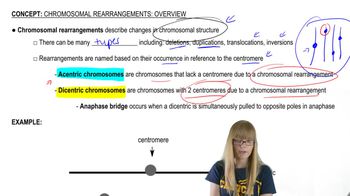
Chromosomal mosaicism can arise from errors during cell division, such as nondisjunction, where chromosomes fail to separate properly, or anaphase lag, where a chromosome is lost during mitosis. These mechanisms explain how some cells lose an X chromosome after fertilization, producing the observed mosaic karyotype.
Recommended video:
Guided course
04:38
Rearrangement Overview
Related Practice
Textbook Question

A boy with Klinefelter syndrome (47,XXY) is born to a mother who is phenotypically normal and a father who has the X-linked skin condition called anhidrotic ectodermal dysplasia. The mother's skin is completely normal with no signs of the skin abnormality. In contrast, her son has patches of normal skin and patches of abnormal skin.

Using the appropriate genetic terminology, describe the meiotic mistake that occurred. Be sure to indicate in which division the mistake occurred.

1525
views
Textbook Question

A boy with Klinefelter syndrome (47,XXY) is born to a mother who is phenotypically normal and a father who has the X-linked skin condition called anhidrotic ectodermal dysplasia. The mother's skin is completely normal with no signs of the skin abnormality. In contrast, her son has patches of normal skin and patches of abnormal skin.

Using the appropriate genetic terminology, explain the son's skin phenotype.

2491
views
Textbook Question
Most cases of Turner syndrome are attributed to nondisjunction of one or more of the sex chromosomes during gametogenesis, from either the male or female parent. However, some females possess a rare form of Turner syndrome in which some of the cells of the body (somatic cells) lack an X chromosome, while other cells have the normal two X chromosomes. Often detected in blood and/or skin cells, such individuals with mosaic Turner syndrome may exhibit relatively mild symptoms. An individual may be specified as 45,X(20)/46,XX(80) if, for example, 20 percent of the cells examined were X monosomic. How might mitotic events cause such mosaicism, and what parameter(s) would likely determine the percentages and distributions of X0 cells?
1319
views
Textbook Question

A normal female is discovered with 45 chromosomes, one of which exhibits a Robertsonian translocation containing most of chromosomes 15 and 21. Discuss the possible outcomes in her offspring when her husband contains a normal karyotype.

895
views