Pearson+ LogoPearson+ Logo
Ch. 8 - Chromosome Mutations: Variation in Number and Arrangement
Klug - Concepts of Genetics  12th Edition
Klug12th EditionConcepts of Genetics ISBN: 9780135564776Not the one you use?Change textbook
Chapter 8, Problem 27b

A boy with Klinefelter syndrome (47,XXY) is born to a mother who is phenotypically normal and a father who has the X-linked skin condition called anhidrotic ectodermal dysplasia. The mother's skin is completely normal with no signs of the skin abnormality. In contrast, her son has patches of normal skin and patches of abnormal skin.
Using the appropriate genetic terminology, describe the meiotic mistake that occurred. Be sure to indicate in which division the mistake occurred.

Verified step by step guidance
1
Step 1: Understand the genetic background of the problem. The boy has Klinefelter syndrome (47,XXY), meaning he has two X chromosomes and one Y chromosome. The mother is phenotypically normal and does not show the X-linked skin condition, while the father has the X-linked condition (anhidrotic ectodermal dysplasia).
Step 2: Recognize that the son’s phenotype shows patches of normal and abnormal skin, which suggests mosaicism due to X-chromosome inactivation (lyonization). This occurs because females (XX) randomly inactivate one X chromosome in each cell, leading to a mosaic pattern if one X carries a mutation.
Step 3: Since the son has two X chromosomes, one from the mother and one from the father, and the father has the mutant X, the presence of both normal and abnormal skin patches indicates that the son inherited both X chromosomes and that X-inactivation is causing the mosaic phenotype.
Step 4: Identify the meiotic error: the mother must have contributed two X chromosomes instead of one, indicating nondisjunction during meiosis. Determine whether this nondisjunction occurred in meiosis I or meiosis II by considering the genetic consequences of each division.
Step 5: Conclude that the nondisjunction likely occurred during maternal meiosis I, where homologous chromosomes fail to separate, resulting in an egg with two X chromosomes. Fertilization with a Y-bearing sperm from the father leads to a 47,XXY karyotype in the son.

Verified video answer for a similar problem:

This video solution was recommended by our tutors as helpful for the problem above.
Video duration:
2m
Was this helpful?

Key Concepts

Here are the essential concepts you must grasp in order to answer the question correctly.

Klinefelter Syndrome (47,XXY)

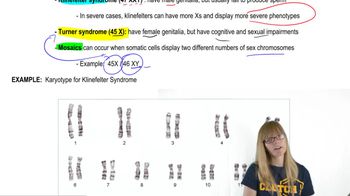
Klinefelter syndrome is a chromosomal condition where a male has an extra X chromosome, resulting in a 47,XXY karyotype. It arises due to nondisjunction during meiosis, leading to an abnormal number of sex chromosomes. This syndrome affects male development and is key to understanding the genetic background of the boy in the question.
Recommended video:
Guided course
10:35
Human Sex Chromosomes

Nondisjunction in Meiosis I and II

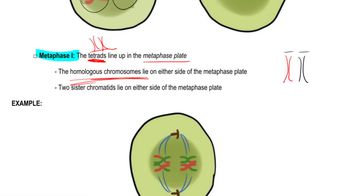
Nondisjunction is the failure of homologous chromosomes or sister chromatids to separate properly during meiosis. If it occurs in meiosis I, homologous chromosomes fail to separate; if in meiosis II, sister chromatids fail to separate. Identifying the division where nondisjunction happened explains the origin of abnormal chromosome numbers in gametes.
Recommended video:
Guided course
09:06
Meiosis Steps

X-linked Inheritance and Mosaicism due to X-inactivation

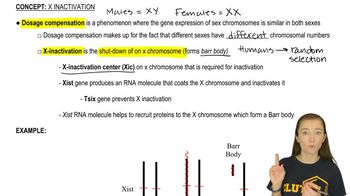
X-linked conditions are caused by mutations on the X chromosome. Females have two X chromosomes and undergo X-inactivation, randomly silencing one X in each cell, leading to mosaic expression. The boy’s patchy skin reflects mosaicism from inheriting two X chromosomes with different alleles, explaining the mixed normal and abnormal skin patches.
Recommended video:
Guided course
09:30
X-Inactivation
Related Practice
Textbook Question

The woman in Problem 24 has had two miscarriages. She has come to you, an established genetic counselor, with these questions:

Is there a genetic explanation of her frequent miscarriages?

Should she abandon her attempts to have a child of her own?

If not, what is the chance that she could have a normal child? Provide an informed response to her concerns.

614
views
Textbook Question

In a recent cytogenetic study on 1021 cases of Down syndrome, 46 were the result of translocations, the most frequent of which was symbolized as t(14;21). What does this symbol represent, and how many chromosomes would you expect to be present in t(14;21) Down syndrome individuals?

667
views
Textbook Question

A boy with Klinefelter syndrome (47,XXY) is born to a mother who is phenotypically normal and a father who has the X-linked skin condition called anhidrotic ectodermal dysplasia. The mother's skin is completely normal with no signs of the skin abnormality. In contrast, her son has patches of normal skin and patches of abnormal skin.

Which parent contributed the abnormal gamete?

2301
views
Textbook Question

A boy with Klinefelter syndrome (47,XXY) is born to a mother who is phenotypically normal and a father who has the X-linked skin condition called anhidrotic ectodermal dysplasia. The mother's skin is completely normal with no signs of the skin abnormality. In contrast, her son has patches of normal skin and patches of abnormal skin.

Using the appropriate genetic terminology, explain the son's skin phenotype.

2491
views
Textbook Question
Most cases of Turner syndrome are attributed to nondisjunction of one or more of the sex chromosomes during gametogenesis, from either the male or female parent. However, some females possess a rare form of Turner syndrome in which some of the cells of the body (somatic cells) lack an X chromosome, while other cells have the normal two X chromosomes. Often detected in blood and/or skin cells, such individuals with mosaic Turner syndrome may exhibit relatively mild symptoms. An individual may be specified as 45,X(20)/46,XX(80) if, for example, 20 percent of the cells examined were X monosomic. How might mitotic events cause such mosaicism, and what parameter(s) would likely determine the percentages and distributions of X0 cells?
1319
views
Textbook Question

A 3-year-old child exhibited some early indication of Turner syndrome, which results from a 45,X chromosome composition. Karyotypic analysis demonstrated two cell types: 46,XX (normal) and 45,X. Propose a mechanism for the origin of this mosaicism.

880
views