Pearson+ LogoPearson+ Logo
Ch. 8 - Chromosome Mutations: Variation in Number and Arrangement
Klug - Concepts of Genetics  12th Edition
Klug12th EditionConcepts of Genetics ISBN: 9780135564776Not the one you use?Change textbook
Chapter 8, Problem 30

A normal female is discovered with 45 chromosomes, one of which exhibits a Robertsonian translocation containing most of chromosomes 15 and 21. Discuss the possible outcomes in her offspring when her husband contains a normal karyotype.

Verified step by step guidance
1
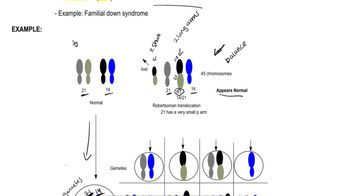
Step 1: Understand the nature of the Robertsonian translocation. A Robertsonian translocation occurs when two acrocentric chromosomes fuse near their centromeres, resulting in a single chromosome that contains most of the genetic material from both original chromosomes. In this case, chromosomes 15 and 21 are involved, and the female has 45 chromosomes due to this fusion.
Step 2: Recognize that the female is a balanced carrier. Since she has 45 chromosomes but is phenotypically normal, it means she carries a balanced translocation where no genetic material is lost or gained overall. However, during meiosis, the segregation of this translocation chromosome can produce unbalanced gametes.
Step 3: Analyze the possible meiotic segregation patterns. During gamete formation, the translocation chromosome and the normal homologues of chromosomes 15 and 21 can segregate in different ways, leading to several possible gamete types: normal, balanced translocation carrier, or unbalanced with partial trisomy or monosomy of chromosome 15 or 21 segments.
Step 4: Predict the possible offspring karyotypes when the female's gametes combine with the husband's normal gametes. The offspring could be: (a) normal with 46 chromosomes, (b) balanced translocation carriers like the mother, or (c) have unbalanced chromosomal content leading to conditions such as trisomy 21 (Down syndrome) or other chromosomal imbalances, depending on which segments are duplicated or deleted.
Step 5: Summarize the clinical implications. The risk of miscarriage or offspring with chromosomal disorders is increased due to unbalanced gametes. Genetic counseling and possibly prenatal diagnosis would be recommended to assess the specific risks for this couple.

Verified video answer for a similar problem:

This video solution was recommended by our tutors as helpful for the problem above.
Video duration:
3m
Was this helpful?

Key Concepts

Here are the essential concepts you must grasp in order to answer the question correctly.

Robertsonian Translocation

A Robertsonian translocation is a chromosomal rearrangement where two acrocentric chromosomes fuse at their centromeres, forming a single chromosome. This reduces the chromosome number by one but often retains most genetic material. Carriers are usually phenotypically normal but can produce unbalanced gametes, leading to offspring with chromosomal abnormalities.
Recommended video:
Guided course
09:31
Robertsonian Translocations

Chromosome Number and Karyotype

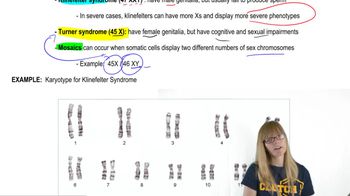
Humans typically have 46 chromosomes, arranged in 23 pairs. A karyotype shows the number and structure of chromosomes. A female with 45 chromosomes due to a Robertsonian translocation has one fused chromosome, which can affect segregation during meiosis and influence the chromosomal makeup of her offspring.
Recommended video:
Guided course
10:35
Human Sex Chromosomes

Genetic Outcomes in Offspring from Translocation Carriers

When a translocation carrier mates with a normal individual, offspring may inherit normal chromosomes, balanced translocations, or unbalanced chromosomal complements. Unbalanced gametes can cause miscarriages or syndromes like Down syndrome if extra genetic material from chromosome 21 is present. Understanding segregation patterns helps predict these outcomes.
Recommended video:
Guided course
09:31
Robertsonian Translocations