Pearson+ LogoPearson+ Logo
Ch. 8 - Chromosome Mutations: Variation in Number and Arrangement
Klug - Concepts of Genetics  12th Edition
Klug12th EditionConcepts of Genetics ISBN: 9780135564776Not the one you use?Change textbook
Chapter 8, Problem 1b

How do we know that human aneuploidy for each of the 22 autosomes occurs at conception, even though most often human aneuploids do not survive embryonic or fetal development and thus are never observed at birth?

Verified step by step guidance
1
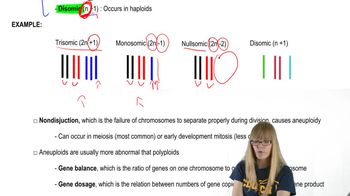
Understand the definition of aneuploidy: it is the presence of an abnormal number of chromosomes in a cell, such as having an extra or missing chromosome.
Recognize that although many aneuploid embryos do not survive to birth, scientists can detect aneuploidy at very early stages of development, such as at conception or shortly after fertilization.
Learn about techniques like preimplantation genetic diagnosis (PGD) and fluorescence in situ hybridization (FISH), which allow researchers to analyze the chromosome number in single cells from early embryos before implantation.
Consider cytogenetic studies of miscarried embryos and fetuses, which reveal the presence of aneuploidy in many cases, indicating that aneuploidy occurs early but often leads to developmental failure.
Combine evidence from early embryo testing and studies of spontaneous abortions to conclude that aneuploidy for all 22 autosomes arises at conception, even if most affected embryos do not survive to birth.

Verified video answer for a similar problem:

This video solution was recommended by our tutors as helpful for the problem above.
Video duration:
2m
Was this helpful?

Key Concepts

Here are the essential concepts you must grasp in order to answer the question correctly.

Aneuploidy and Its Definition

Aneuploidy refers to the presence of an abnormal number of chromosomes in a cell, such as having an extra or missing chromosome. In humans, this often involves one of the 22 autosomes and can disrupt normal development. Understanding aneuploidy is essential to grasp why some embryos fail to develop properly.
Recommended video:

Detection of Aneuploidy at Conception

Techniques like preimplantation genetic diagnosis (PGD) and analysis of products of conception allow detection of aneuploidy very early, often at or shortly after fertilization. These methods reveal that aneuploid embryos are formed frequently, even if they do not survive to birth, providing evidence of aneuploidy at conception.
Recommended video:

Embryonic and Fetal Selection Against Aneuploidy

Most aneuploid embryos fail to develop due to natural selection during embryonic and fetal stages, leading to miscarriage or early pregnancy loss. This selective loss explains why aneuploidy is rarely observed in live births despite its high occurrence at conception.
Recommended video: