How do we know that the extra chromosome causing Down syndrome is usually maternal in origin?
Ch. 8 - Chromosome Mutations: Variation in Number and Arrangement

All textbooks
Klug 12th Edition
Ch. 8 - Chromosome Mutations: Variation in Number and Arrangement
Problem 1c
Klug 12th Edition
Ch. 8 - Chromosome Mutations: Variation in Number and Arrangement
Problem 1cChapter 8, Problem 1c
How do we know that specific mutant phenotypes are due to changes in chromosome number or structure?
Verified step by step guidance1
Understand that mutant phenotypes caused by changes in chromosome number or structure are often identified through cytogenetic analysis, which involves examining the chromosomes under a microscope to detect abnormalities such as deletions, duplications, inversions, translocations, or aneuploidy.
Use karyotyping techniques to visualize the complete set of chromosomes from an individual and compare the chromosome number and structure to a normal reference to identify any deviations that correlate with the mutant phenotype.
Perform genetic mapping and linkage analysis to determine if the mutant phenotype co-segregates with known chromosomal rearrangements or aneuploid conditions, which helps establish a connection between the phenotype and chromosomal changes.
Apply molecular techniques such as fluorescence in situ hybridization (FISH) or comparative genomic hybridization (CGH) to detect specific structural changes or copy number variations in chromosomes that may underlie the mutant phenotype.
Correlate the observed chromosomal abnormalities with the mutant phenotype by studying multiple individuals or cell lines, ensuring that the phenotype consistently associates with the chromosomal change, thereby confirming causality.

Verified video answer for a similar problem:
This video solution was recommended by our tutors as helpful for the problem above.
Video duration:
1mWas this helpful?
Key Concepts
Here are the essential concepts you must grasp in order to answer the question correctly.
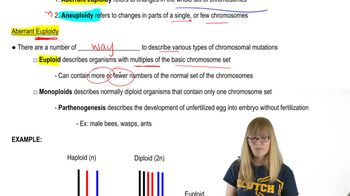
Chromosomal Aberrations
Chromosomal aberrations refer to changes in chromosome number or structure, such as deletions, duplications, inversions, translocations, or aneuploidy. These alterations can disrupt gene function or regulation, leading to mutant phenotypes. Identifying these aberrations helps link specific phenotypes to chromosomal changes.
Recommended video:
Guided course
Aberrant Euploid
Karyotyping and Cytogenetic Analysis
Karyotyping is a laboratory technique that visualizes chromosomes under a microscope to detect numerical or structural abnormalities. Cytogenetic analysis allows researchers to correlate observed mutant phenotypes with specific chromosomal changes by comparing normal and mutant chromosome sets.
Recommended video:
Guided course
Chi Square Analysis
Genotype-Phenotype Correlation
Genotype-phenotype correlation involves linking specific genetic changes, such as chromosomal mutations, to observable traits or phenotypes. By studying inheritance patterns and molecular markers, scientists can determine if a mutant phenotype results from chromosomal alterations.
Recommended video:
Guided course
Gamete Genotypes
Related Practice
Textbook Question
589
views
Textbook Question
How do we know that human aneuploidy for each of the 22 autosomes occurs at conception, even though most often human aneuploids do not survive embryonic or fetal development and thus are never observed at birth?
504
views
Textbook Question
How do we know that the mutant Bar-eye phenotype in Drosophila is due to a duplicated gene region rather than to a change in the nucleotide sequence of a gene?
373
views
Textbook Question
Write a short essay that discusses five altered phenotypes that result from specific chromosomal aberrations.
442
views
Textbook Question
Define these pairs of terms, and distinguish between them.
aneuploidy/ euploidy
monosomy/ trisomy
Patau syndrome/ Edwards syndrome
autopolyploidy/ allopolyploidy
autotetraploid/ amphidiploid
paracentric inversion/ pericentric inversion
656
views