Pearson+ LogoPearson+ Logo
Ch. 9 - Extranuclear Inheritance
Klug - Concepts of Genetics  12th Edition
Klug12th EditionConcepts of Genetics ISBN: 9780135564776Not the one you use?Change textbook
Chapter 9, Problem 18a

Mutations in mitochondrial DNA appear to be responsible for a number of neurological disorders, including myoclonic epilepsy and ragged-red fiber disease, Leber's hereditary optic neuropathy, and Kearns-Sayre syndrome. In each case, the disease phenotype is expressed when the ratio of mutant to wild-type mitochondria exceeds a threshold peculiar to each disease, but usually in the 60 to 95 percent range.
Given that these are debilitating conditions, why has no cure been developed? Can you suggest a general approach that might be used to treat, or perhaps even cure, these disorders?

Verified step by step guidance
1
Understand the problem: Mitochondrial DNA mutations are responsible for several neurological disorders. These disorders manifest when the ratio of mutant to wild-type mitochondria exceeds a specific threshold. The challenge lies in developing a cure due to the unique nature of mitochondrial inheritance and the difficulty in targeting mitochondria therapeutically.
Step 1: Explain why a cure is challenging. Mitochondrial DNA is inherited maternally, and each cell contains multiple mitochondria (heteroplasmy). The ratio of mutant to wild-type mitochondria can vary between cells and tissues, making it difficult to uniformly target and correct the mutation across the body.
Step 2: Discuss the limitations of current treatments. Current therapies focus on managing symptoms rather than addressing the underlying genetic cause. This is because directly editing or replacing mitochondrial DNA is technically challenging due to the double membrane of mitochondria and the lack of efficient delivery systems for therapeutic agents.
Step 3: Suggest a general approach for treatment. One potential strategy is mitochondrial replacement therapy (MRT), where defective mitochondria are replaced with healthy ones. This could be achieved during in vitro fertilization by transferring the nuclear DNA from an affected egg into a donor egg with healthy mitochondria.
Step 4: Explore gene-editing technologies. Another approach could involve using advanced gene-editing tools, such as CRISPR-Cas9 or mitochondrial-specific nucleases, to selectively target and repair mutant mitochondrial DNA. However, this requires further research to ensure precision and safety in targeting mitochondrial genomes.

Verified video answer for a similar problem:

This video solution was recommended by our tutors as helpful for the problem above.
Video duration:
1m
Was this helpful?

Key Concepts

Here are the essential concepts you must grasp in order to answer the question correctly.

Mitochondrial DNA and Mutations

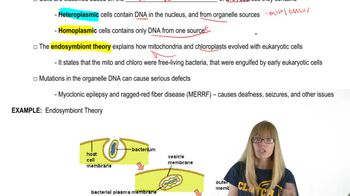
Mitochondrial DNA (mtDNA) is distinct from nuclear DNA and is inherited maternally. Mutations in mtDNA can disrupt the normal function of mitochondria, which are crucial for energy production in cells. These mutations can lead to various diseases, particularly affecting tissues with high energy demands, such as the nervous system. Understanding the types and effects of these mutations is essential for addressing mitochondrial disorders.
Recommended video:
Guided course
04:11
Organelle DNA Characteristics

Threshold Effect in Mitochondrial Disorders

The threshold effect refers to the phenomenon where a certain proportion of mutant mitochondria must be present for a disease phenotype to manifest. In mitochondrial disorders, this threshold typically ranges from 60% to 95% mutant mitochondria. This concept is critical for understanding why individuals may exhibit symptoms at different stages of life and why some may remain asymptomatic despite carrying mutations.
Recommended video:
Guided course
03:38
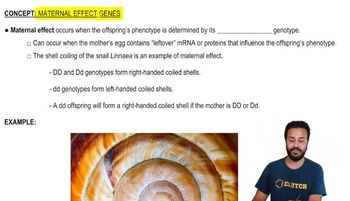
Maternal Effect

Current Treatment Approaches and Challenges

Current treatments for mitochondrial disorders primarily focus on managing symptoms rather than curing the underlying genetic issues. Challenges in developing cures include the complexity of mitochondrial genetics, the difficulty in targeting and repairing mtDNA, and the need for therapies that can effectively reach affected tissues. Research into gene therapy, mitochondrial replacement techniques, and pharmacological interventions represents potential avenues for future treatments.
Recommended video:
Guided course
05:48
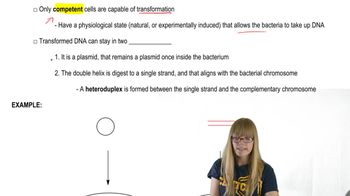
Transformation
Related Practice
Textbook Question

The maternal-effect mutation bicoid (bcd) is recessive. In the absence of the bicoid protein product, embryogenesis is not completed. Consider a cross between a female heterozygous for the bicoid alleles (bcd⁺/bcd⁻) and a male homozygous for the mutation (bcd⁻/bcd⁻).

Predict the outcome (normal vs. failed embryogenesis) in the F₁ and F₂ generations of the cross described.

443
views
Textbook Question

The maternal-effect mutation bicoid (bcd) is recessive. In the absence of the bicoid protein product, embryogenesis is not completed. Consider a cross between a female heterozygous for the bicoid alleles (bcd⁺/bcd⁻) and a male homozygous for the mutation (bcd⁻/bcd⁻).

How is it possible for a male homozygous for the mutation to exist?

722
views
Textbook Question

(a) In humans the mitochondrial genome encodes a low number of proteins, rRNAs, and tRNAs but imports approximately 1100 proteins encoded by the nuclear genome. Yet, with such a small proportion from the mitochondrial genome encoding proteins and RNAs, a disproportionately high number of genetic disorders due to mtDNA mutations have been identified [Bigger, B. et al. (1999)]. What inheritance pattern would you expect in a three-generation pedigree in which the grandfather expresses the initial mtDNA defect? What inheritance pattern would you expect in a three-generation pedigree in which the grandmother expresses the initial mtDNA defect?

(b) Considering the description in part (a) above, how would your pedigrees change if you knew that the mutation that caused the mitochondrial defect was recessive and located in the nuclear genome, was successfully transported into mitochondria, and negated a physiologically important mitochondrial function?

665
views
Textbook Question

Mutations in mitochondrial DNA appear to be responsible for a number of neurological disorders, including myoclonic epilepsy and ragged-red fiber disease, Leber's hereditary optic neuropathy, and Kearns-Sayre syndrome. In each case, the disease phenotype is expressed when the ratio of mutant to wild-type mitochondria exceeds a threshold peculiar to each disease, but usually in the 60 to 95 percent range.

Compared with the vast number of mitochondria in an embryo, the number of mitochondria in an ovum is relatively small. Might such an ooplasmic mitochondrial bottleneck present an opportunity for therapy or cure? Explain.

860
views
Textbook Question

Researchers examined a family with an interesting distribution of Leigh syndrome symptoms. In this disorder, individuals may show a progressive loss of motor function (ataxia, A) with peripheral neuropathy (PN, meaning impairment of the peripheral nerves). A mitochondrial DNA (mtDNA) mutation that reduces ATPase activity was identified in various tissues of affected individuals. The accompanying table summarizes the presence of symptoms in an extended family.

Develop a pedigree that summarizes the information presented in the table.

518
views
Textbook Question

Researchers examined a family with an interesting distribution of Leigh syndrome symptoms. In this disorder, individuals may show a progressive loss of motor function (ataxia, A) with peripheral neuropathy (PN, meaning impairment of the peripheral nerves). A mitochondrial DNA (mtDNA) mutation that reduces ATPase activity was identified in various tissues of affected individuals. The accompanying table summarizes the presence of symptoms in an extended family.

Provide an explanation for the pattern of inheritance of the disease. What term describes this pattern?

474
views