Pearson+ LogoPearson+ Logo
Ch. 9 - Extranuclear Inheritance
Klug - Concepts of Genetics  12th Edition
Klug12th EditionConcepts of Genetics ISBN: 9780135564776Not the one you use?Change textbook
Chapter 9, Problem 16a

The maternal-effect mutation bicoid (bcd) is recessive. In the absence of the bicoid protein product, embryogenesis is not completed. Consider a cross between a female heterozygous for the bicoid alleles (bcd⁺/bcd⁻) and a male homozygous for the mutation (bcd⁻/bcd⁻).
How is it possible for a male homozygous for the mutation to exist?

Verified step by step guidance
1
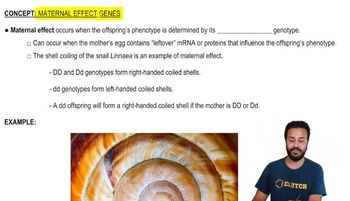
Understand the concept of maternal-effect genes: Maternal-effect genes are genes whose products are provided by the mother and are required for early embryonic development. The phenotype of the offspring is determined by the genotype of the mother, not the offspring itself.
Recognize that the bicoid (bcd) gene is a maternal-effect gene: The bicoid protein is essential for embryogenesis, and its absence leads to failure in development. However, the genotype of the offspring does not directly affect its survival; it is the genotype of the mother that determines whether the offspring receives the necessary bicoid protein.
Analyze the genotype of the male homozygous for the mutation (bcd⁻/bcd⁻): A male homozygous for the bcd⁻ mutation can exist if his mother was heterozygous (bcd⁺/bcd⁻). The heterozygous mother would produce enough bicoid protein to support embryogenesis, allowing the male offspring to survive despite being homozygous for the mutation.
Consider the implications of the maternal-effect gene: Since the bicoid protein is provided by the mother, the survival of the offspring depends on whether the mother has at least one functional bcd⁺ allele. The offspring's genotype (bcd⁺/bcd⁻ or bcd⁻/bcd⁻) does not affect its ability to survive embryogenesis as long as the mother provides the necessary protein.
Conclude that the male homozygous for the mutation exists because his heterozygous mother (bcd⁺/bcd⁻) provided sufficient bicoid protein during embryogenesis, allowing him to develop and survive despite his genotype.

Verified video answer for a similar problem:

This video solution was recommended by our tutors as helpful for the problem above.
Video duration:
1m
Was this helpful?

Key Concepts

Here are the essential concepts you must grasp in order to answer the question correctly.

Maternal Effect Genes

Maternal effect genes are genes expressed in the mother that influence the development of the offspring. The products of these genes, such as proteins or RNAs, are deposited in the egg and play crucial roles in early embryonic development. In the case of bicoid, the protein is essential for establishing the anterior-posterior axis in the embryo, and its absence leads to developmental failure.
Recommended video:
Guided course
03:38
Maternal Effect

Recessive Alleles

Recessive alleles are variants of a gene that do not manifest their traits in the presence of a dominant allele. In the context of the bicoid mutation, the bcd⁻ allele is recessive, meaning that an individual must inherit two copies of this allele (homozygous) to express the associated phenotype. This explains how a male homozygous for the bicoid mutation can exist if he inherits the recessive allele from both parents.
Recommended video:
Guided course
03:03
New Alleles and Migration

Genetic Crosses and Inheritance Patterns

Genetic crosses involve mating individuals with known genotypes to study inheritance patterns of traits. In this scenario, a heterozygous female (bcd⁺/bcd⁻) can produce offspring with varying genotypes, including homozygous recessive males (bcd⁻/bcd⁻). Understanding these patterns helps explain how recessive traits can appear in offspring even when one parent does not express the trait.
Recommended video:
Guided course
26:08
Trihybrid Cross
Related Practice
Textbook Question

Mitochondrial replacement therapy (MRT) offers a potential solution for women with mtDNA-based diseases to have healthy children. Based on what you know about the importance of nuclear gene products to mitochondrial functions, will MRT ensure that children will not inherit or develop a mtDNA-based diseases?

535
views
Textbook Question

The specification of the anterior–posterior axis in Drosophila embryos is initially controlled by various gene products that are synthesized and stored in the mature egg following oogenesis. Mutations in these genes result in abnormalities of the axis during embryogenesis. These mutations illustrate maternal effect. How do such mutations vary from those produced by organelle heredity? Devise a set of parallel crosses and expected outcomes involving mutant genes that contrast maternal effect and organelle heredity.

826
views
Textbook Question

The maternal-effect mutation bicoid (bcd) is recessive. In the absence of the bicoid protein product, embryogenesis is not completed. Consider a cross between a female heterozygous for the bicoid alleles (bcd⁺/bcd⁻) and a male homozygous for the mutation (bcd⁻/bcd⁻).

Predict the outcome (normal vs. failed embryogenesis) in the F₁ and F₂ generations of the cross described.

443
views
Textbook Question

(a) In humans the mitochondrial genome encodes a low number of proteins, rRNAs, and tRNAs but imports approximately 1100 proteins encoded by the nuclear genome. Yet, with such a small proportion from the mitochondrial genome encoding proteins and RNAs, a disproportionately high number of genetic disorders due to mtDNA mutations have been identified [Bigger, B. et al. (1999)]. What inheritance pattern would you expect in a three-generation pedigree in which the grandfather expresses the initial mtDNA defect? What inheritance pattern would you expect in a three-generation pedigree in which the grandmother expresses the initial mtDNA defect?

(b) Considering the description in part (a) above, how would your pedigrees change if you knew that the mutation that caused the mitochondrial defect was recessive and located in the nuclear genome, was successfully transported into mitochondria, and negated a physiologically important mitochondrial function?

665
views
Textbook Question

Mutations in mitochondrial DNA appear to be responsible for a number of neurological disorders, including myoclonic epilepsy and ragged-red fiber disease, Leber's hereditary optic neuropathy, and Kearns-Sayre syndrome. In each case, the disease phenotype is expressed when the ratio of mutant to wild-type mitochondria exceeds a threshold peculiar to each disease, but usually in the 60 to 95 percent range.

Given that these are debilitating conditions, why has no cure been developed? Can you suggest a general approach that might be used to treat, or perhaps even cure, these disorders?

867
views
Textbook Question

Mutations in mitochondrial DNA appear to be responsible for a number of neurological disorders, including myoclonic epilepsy and ragged-red fiber disease, Leber's hereditary optic neuropathy, and Kearns-Sayre syndrome. In each case, the disease phenotype is expressed when the ratio of mutant to wild-type mitochondria exceeds a threshold peculiar to each disease, but usually in the 60 to 95 percent range.

Compared with the vast number of mitochondria in an embryo, the number of mitochondria in an ovum is relatively small. Might such an ooplasmic mitochondrial bottleneck present an opportunity for therapy or cure? Explain.

860
views