Pearson+ LogoPearson+ Logo
Ch. 9 - Extranuclear Inheritance
Klug - Concepts of Genetics  12th Edition
Klug12th EditionConcepts of Genetics ISBN: 9780135564776Not the one you use?Change textbook
Chapter 9, Problem 19d

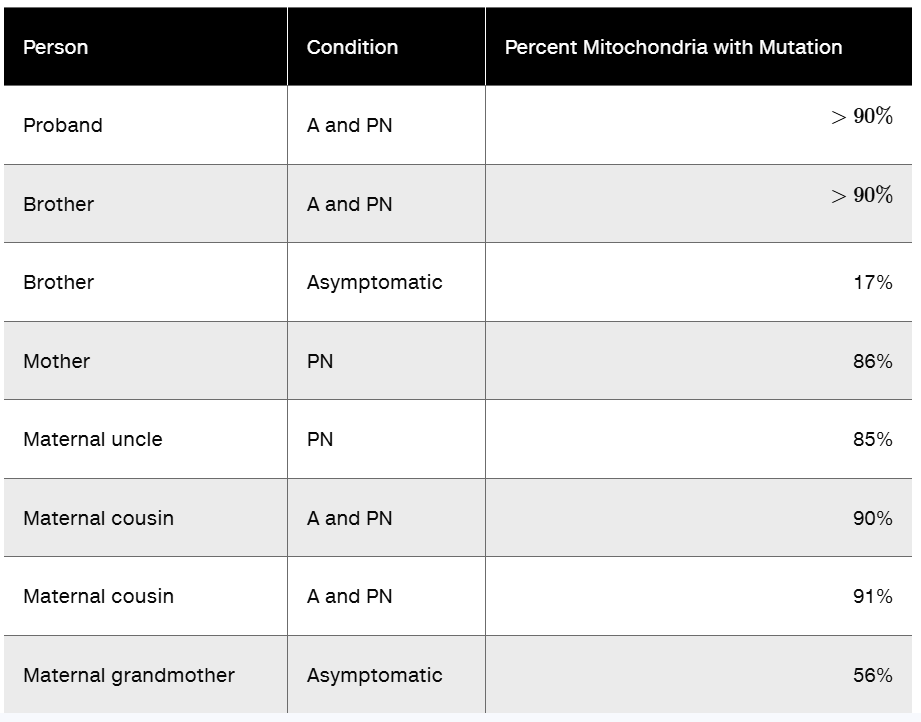
Researchers examined a family with an interesting distribution of Leigh syndrome symptoms. In this disorder, individuals may show a progressive loss of motor function (ataxia, A) with peripheral neuropathy (PN, meaning impairment of the peripheral nerves). A mitochondrial DNA (mtDNA) mutation that reduces ATPase activity was identified in various tissues of affected individuals. The accompanying table summarizes the presence of symptoms in an extended family.
Table listing family members, their Leigh syndrome symptoms, and percent mitochondria with mutation, showing varied symptom presence.
In what way does a condition caused by mtDNA differ in expression and transmission from a mutation that causes albinism?

Verified step by step guidance
1
Understand the key difference between mitochondrial DNA (mtDNA) inheritance and nuclear DNA inheritance. mtDNA is inherited exclusively from the mother, while nuclear DNA mutations, such as those causing albinism, follow Mendelian inheritance patterns (autosomal recessive in the case of albinism).
Recognize that mtDNA mutations, like the one causing Leigh syndrome in this family, exhibit heteroplasmy. This means that cells can contain a mixture of normal and mutated mtDNA, and the proportion of mutated mtDNA can vary between individuals and tissues, influencing the severity of symptoms.
Note that the expression of mtDNA-related conditions depends on the threshold effect. Symptoms manifest when the proportion of mutated mtDNA exceeds a certain threshold, which explains why some family members with lower percentages of mutated mtDNA (e.g., 17% or 56%) are asymptomatic.
Contrast this with albinism, which is caused by mutations in nuclear genes and follows a predictable autosomal recessive inheritance pattern. In albinism, an individual must inherit two copies of the mutated gene (one from each parent) to express the condition, and there is no variability in expression due to heteroplasmy.
Finally, understand that mtDNA mutations are transmitted maternally, meaning only mothers pass mtDNA mutations to their offspring, while nuclear DNA mutations like those causing albinism can be inherited from either parent. This explains why all affected individuals in the family with Leigh syndrome are related through the maternal line.

Verified video answer for a similar problem:

This video solution was recommended by our tutors as helpful for the problem above.
Video duration:
3m
Was this helpful?

Key Concepts

Here are the essential concepts you must grasp in order to answer the question correctly.

Mitochondrial Inheritance

Mitochondrial inheritance refers to the transmission of genetic material found in mitochondria, which is passed exclusively from mother to offspring. This type of inheritance can lead to conditions like Leigh syndrome, where symptoms can vary significantly among individuals, even within the same family. Understanding this pattern is crucial for analyzing how mitochondrial mutations affect different family members.
Recommended video:
Guided course
05:13
Organelle Inheritance

Mitochondrial DNA (mtDNA) Mutations

Mitochondrial DNA mutations can impair cellular energy production, as seen in Leigh syndrome, where a mutation reduces ATPase activity. These mutations can lead to a range of symptoms, including ataxia and peripheral neuropathy, depending on the percentage of affected mitochondria in different tissues. This contrasts with nuclear DNA mutations, which can have different patterns of expression and inheritance.
Recommended video:
Guided course
04:11
Organelle DNA Characteristics

Autosomal Recessive Inheritance

Albinism is typically inherited in an autosomal recessive manner, meaning that an individual must inherit two copies of the mutated gene (one from each parent) to express the condition. This contrasts with mitochondrial disorders, where the maternal lineage determines inheritance, and symptoms can manifest variably even with the same mutation. Understanding these differences is essential for comparing the expression and transmission of genetic conditions.
Recommended video:
Guided course
09:08
Autosomal Pedigrees
Related Practice
Textbook Question

Researchers examined a family with an interesting distribution of Leigh syndrome symptoms. In this disorder, individuals may show a progressive loss of motor function (ataxia, A) with peripheral neuropathy (PN, meaning impairment of the peripheral nerves). A mitochondrial DNA (mtDNA) mutation that reduces ATPase activity was identified in various tissues of affected individuals. The accompanying table summarizes the presence of symptoms in an extended family.

Develop a pedigree that summarizes the information presented in the table.

518
views
Textbook Question

Researchers examined a family with an interesting distribution of Leigh syndrome symptoms. In this disorder, individuals may show a progressive loss of motor function (ataxia, A) with peripheral neuropathy (PN, meaning impairment of the peripheral nerves). A mitochondrial DNA (mtDNA) mutation that reduces ATPase activity was identified in various tissues of affected individuals. The accompanying table summarizes the presence of symptoms in an extended family.

Provide an explanation for the pattern of inheritance of the disease. What term describes this pattern?

474
views
Textbook Question

Researchers examined a family with an interesting distribution of Leigh syndrome symptoms. In this disorder, individuals may show a progressive loss of motor function (ataxia, A) with peripheral neuropathy (PN, meaning impairment of the peripheral nerves). A mitochondrial DNA (mtDNA) mutation that reduces ATPase activity was identified in various tissues of affected individuals. The accompanying table summarizes the presence of symptoms in an extended family.

How can some individuals in the same family show such variation in symptoms? What term, as related to organelle heredity, describes such variation?

533
views
Textbook Question

Payne, B. A. et al. (2013) present evidence that a low level of heteroplasmic mtDNA exists in all tested healthy individuals.

What are two likely sources of such heteroplasmy?

359
views
Textbook Question

Payne, B. A. et al. (2013) present evidence that a low level of heteroplasmic mtDNA exists in all tested healthy individuals.

What genetic conditions within a given mitochondrion are likely to contribute to such a variable pool of mitochondria?

409
views
Textbook Question

The mtDNA accumulates mutations at a rate approximately ten times faster than nuclear DNA. Thus geneticists can use mtDNA variations as a 'molecular clock' to study genetic variation and the movement of ancestral human populations from Africa to different areas of the world more than 125,000 years ago. Propose an explanation for how an analysis of mtDNA can be used to construct family trees of human evolution.

404
views