
Pearson+ LogoPearson+ Logo
Ch. 9 - Extranuclear Inheritance
Klug - Concepts of Genetics  12th Edition
Klug12th EditionConcepts of Genetics ISBN: 9780135564776Not the one you use?Change textbook
Chapter 9, Problem 21

The mtDNA accumulates mutations at a rate approximately ten times faster than nuclear DNA. Thus geneticists can use mtDNA variations as a 'molecular clock' to study genetic variation and the movement of ancestral human populations from Africa to different areas of the world more than 125,000 years ago. Propose an explanation for how an analysis of mtDNA can be used to construct family trees of human evolution.

Verified step by step guidance
1
Understand the unique properties of mitochondrial DNA (mtDNA): mtDNA is inherited maternally, meaning it is passed down from mother to offspring without recombination. This makes it a useful tool for tracing direct maternal lineages over generations.
Recognize the high mutation rate of mtDNA: mtDNA accumulates mutations approximately ten times faster than nuclear DNA. These mutations serve as genetic markers that can differentiate between populations and lineages over time.
Identify the concept of a 'molecular clock': The consistent rate of mtDNA mutation allows geneticists to estimate the time of divergence between different lineages. By comparing the number of mutations between two mtDNA sequences, scientists can infer how long ago their common ancestor lived.
Compare mtDNA sequences across populations: Geneticists collect mtDNA samples from individuals in different populations and analyze the sequence variations. By identifying shared mutations, they can group individuals into haplogroups, which represent common maternal ancestors.
Construct a phylogenetic tree: Using the data from mtDNA sequence comparisons, geneticists build a family tree (phylogenetic tree) that shows the relationships between different haplogroups. This tree helps trace the migration patterns of ancestral human populations and their divergence from a common origin in Africa.

Verified video answer for a similar problem:

This video solution was recommended by our tutors as helpful for the problem above.
Video duration:
2m
Was this helpful?

Key Concepts

Here are the essential concepts you must grasp in order to answer the question correctly.

Mitochondrial DNA (mtDNA)

Mitochondrial DNA is the genetic material found in mitochondria, the energy-producing organelles in cells. Unlike nuclear DNA, mtDNA is inherited maternally and has a higher mutation rate, making it useful for tracing lineage and evolutionary history. Its relatively rapid accumulation of mutations allows researchers to estimate the timing of evolutionary events and the relationships between different populations.
Recommended video:
Guided course
04:11
Organelle DNA Characteristics

Molecular Clock

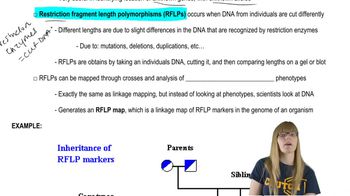
The molecular clock is a technique used in genetics to estimate the time of evolutionary events based on the rate of genetic mutations. By comparing the differences in mtDNA sequences among various populations, scientists can infer how long ago these populations diverged from a common ancestor. This method provides a timeline for human migration and evolution, helping to construct family trees that illustrate the relationships among different human groups.
Recommended video:
Guided course
07:11
Mapping with Markers

Ancestral Human Populations

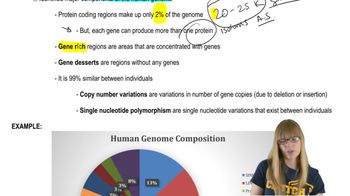
Ancestral human populations refer to the early groups of humans from which modern populations descended. By analyzing mtDNA, researchers can trace back the lineage of these populations, revealing patterns of migration and adaptation over time. Understanding the genetic variations among these ancestral groups helps to reconstruct the history of human evolution and the dispersal of humans from Africa to other parts of the world.
Recommended video:
Guided course
06:51
Human Genome Composition
Related Practice
Textbook Question

Researchers examined a family with an interesting distribution of Leigh syndrome symptoms. In this disorder, individuals may show a progressive loss of motor function (ataxia, A) with peripheral neuropathy (PN, meaning impairment of the peripheral nerves). A mitochondrial DNA (mtDNA) mutation that reduces ATPase activity was identified in various tissues of affected individuals. The accompanying table summarizes the presence of symptoms in an extended family.

In what way does a condition caused by mtDNA differ in expression and transmission from a mutation that causes albinism?

478
views
Textbook Question

Payne, B. A. et al. (2013) present evidence that a low level of heteroplasmic mtDNA exists in all tested healthy individuals.

What are two likely sources of such heteroplasmy?

359
views
Textbook Question

Payne, B. A. et al. (2013) present evidence that a low level of heteroplasmic mtDNA exists in all tested healthy individuals.

What genetic conditions within a given mitochondrion are likely to contribute to such a variable pool of mitochondria?

409
views
Textbook Question

Because offspring inherit the mitochondrial genome only from the mother, evolutionarily the mitochondrial genome in males encounters a dead end. The mitochondrial genome in males has no significant impact on the genetic information of future generations. Scientists have proposed that this can result in an accumulation of mutations that have a negative impact on genetic fitness of males but not females. Experiments with Drosophila support this possibility. What experimental data or evidence would you want to evaluate or consider to determine if an accumulation of mtDNA mutations negatively impacts the fitness of males of any species?

707
views