Pearson+ LogoPearson+ Logo
Ch. 1 - The Molecular Basis of Heredity, Variation, and Evolution
Sanders - Genetic Analysis: An Integrated Approach 3rd Edition
Sanders3rd EditionGenetic Analysis: An Integrated ApproachISBN: 9780135564172Not the one you use?Change textbook
Chapter 1, Problem 29c

Consider the following segment of DNA:
    5'-...ATGCCAGTCACTGACTTG...-3'
    3'-...TACGGTCAGTGACTGAAC...-5'
If the lower strand of DNA serves as the template transcribed into mRNA, how many peptide bonds are present in the polypeptide fragment into which the mRNA is translated?

Verified step by step guidance
1
Identify the template strand of DNA, which is the lower strand in this case (3'-...TACGGTCAGTGACTGAAC...-5'). This strand will be used to synthesize the complementary mRNA sequence.
Determine the mRNA sequence by transcribing the template strand. Replace each base with its complementary RNA base: A pairs with U, T pairs with A, G pairs with C, and C pairs with G. The resulting mRNA sequence will be 5'-...AUGCCAGUCACUGACUUG...-3'.
Locate the start codon (AUG) in the mRNA sequence. This codon signals the beginning of translation and the synthesis of the polypeptide chain.
Divide the mRNA sequence into codons (groups of three nucleotides) starting from the AUG codon. Each codon corresponds to a specific amino acid, except for stop codons, which terminate translation.
Count the number of codons that encode amino acids (excluding the stop codon). The number of peptide bonds in the polypeptide will be one less than the number of amino acids, as each bond links two amino acids together.

Verified video answer for a similar problem:

This video solution was recommended by our tutors as helpful for the problem above.
Video duration:
1m
Was this helpful?

Key Concepts

Here are the essential concepts you must grasp in order to answer the question correctly.

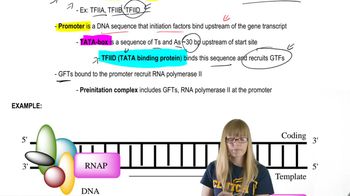
Transcription

Transcription is the process by which the genetic information encoded in DNA is copied into messenger RNA (mRNA). During transcription, RNA polymerase binds to the DNA template strand and synthesizes a complementary RNA strand. The mRNA then carries the genetic code from the nucleus to the ribosome, where it will be translated into a protein.
Recommended video:
Guided course
09:16
Eukaryotic Transcription

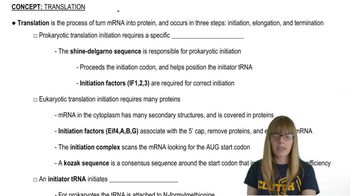
Translation

Translation is the process by which the sequence of nucleotides in mRNA is decoded to produce a specific polypeptide or protein. This occurs in the ribosome, where transfer RNA (tRNA) molecules bring amino acids to the mRNA template according to the codon sequence. Each codon, a sequence of three nucleotides, corresponds to a specific amino acid, and the polypeptide chain is formed through peptide bonds between these amino acids.
Recommended video:
Guided course
07:58
Translation initiation

Peptide Bonds

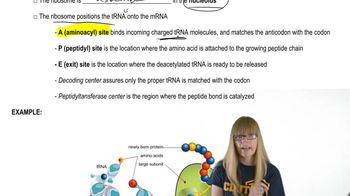
Peptide bonds are the chemical bonds that link amino acids together in a polypeptide chain. They form during the translation process when the carboxyl group of one amino acid reacts with the amino group of another, releasing a molecule of water. The number of peptide bonds in a polypeptide is always one less than the number of amino acids, as the first amino acid does not form a bond with a preceding one.
Recommended video:
Guided course
03:49
Ribosome Structure
Related Practice
Textbook Question

If one is constructing a phylogeny of reptiles using DNA sequence data, which taxon (birds, mammals, amphibians, or fish) might be suitable to use as an outgroup?

1377
views
Textbook Question

Consider the following segment of DNA:

    5'-...ATGCCAGTCACTGACTTG...-3'

    3'-...TACGGTCAGTGACTGAAC...-5'

How many phosphodiester bonds are required to form this segment of double-stranded DNA?

577
views
Textbook Question

Consider the following segment of DNA:

    5'-...ATGCCAGTCACTGACTTG...-3'

    3'-...TACGGTCAGTGACTGAAC...-5'

How many hydrogen bonds are present in this DNA segment?

538
views
Textbook Question

Ethical and social issues have become a large part of the public discussion of genetics and genetic testing. Choose two of the propositions presented here and prepare a list of arguments for and against them.

The results of genetic testing for susceptibility to cancer, heart disease, and diabetes should be available to insurance companies and current or prospective employers to provide more information for decision-making.

397
views
Textbook Question

Ethical and social issues have become a large part of the public discussion of genetics and genetic testing. Choose two of the propositions presented here and prepare a list of arguments for and against them.

Prenatal genetic testing and genetic testing of newborn infants should be available for hereditary conditions that can be treated or managed.

521
views
Textbook Question

Ethical and social issues have become a large part of the public discussion of genetics and genetic testing. Choose two of the propositions presented here and prepare a list of arguments for and against them.

Prenatal genetic testing and genetic testing later in life should be available for hereditary conditions that cannot currently be treated or effectively managed.

540
views