Pearson+ LogoPearson+ Logo
Ch. 1 - The Molecular Basis of Heredity, Variation, and Evolution
Sanders - Genetic Analysis: An Integrated Approach 3rd Edition
Sanders3rd EditionGenetic Analysis: An Integrated ApproachISBN: 9780135564172Not the one you use?Change textbook
Chapter 1, Problem 10a

Define each of the following terms:
Transcription

Verified step by step guidance
1
Transcription is the process by which the genetic information encoded in a DNA sequence is copied into a complementary RNA sequence.
This process occurs in the nucleus of eukaryotic cells and involves the synthesis of messenger RNA (mRNA) from a DNA template.
The enzyme RNA polymerase binds to a specific region of the DNA called the promoter and unwinds the DNA strands to initiate transcription.
RNA polymerase reads the template strand of DNA in the 3' to 5' direction and synthesizes the RNA strand in the 5' to 3' direction by adding complementary RNA nucleotides (A, U, G, C).
Once the RNA strand is fully synthesized, transcription ends at a termination signal, and the RNA molecule is released for further processing or use in protein synthesis.

Verified video answer for a similar problem:

This video solution was recommended by our tutors as helpful for the problem above.
Video duration:
1m
Was this helpful?

Key Concepts

Here are the essential concepts you must grasp in order to answer the question correctly.

Transcription

Transcription is the process by which the genetic information encoded in DNA is copied into messenger RNA (mRNA). This occurs in the nucleus of eukaryotic cells, where RNA polymerase binds to a specific region of the DNA and synthesizes a complementary RNA strand. The resulting mRNA carries the genetic instructions from the DNA to the ribosome, where protein synthesis occurs.
Recommended video:
Guided course
09:16
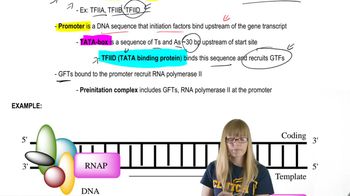
Eukaryotic Transcription

RNA Polymerase

RNA polymerase is the enzyme responsible for synthesizing RNA from a DNA template during transcription. It unwinds the DNA double helix and catalyzes the formation of RNA nucleotides into a growing RNA strand. There are different types of RNA polymerases in eukaryotic cells, each responsible for transcribing different types of genes, such as mRNA, rRNA, and tRNA.
Recommended video:

Promoter Region

The promoter region is a specific sequence of DNA located upstream of a gene that signals the start of transcription. It contains binding sites for RNA polymerase and transcription factors, which are essential for initiating the transcription process. The strength and accessibility of the promoter can influence the rate of gene expression, making it a critical element in gene regulation.
Recommended video:
Guided course
00:30
Regions of X Chromosomes