Pearson+ LogoPearson+ Logo
Ch. 1 - The Molecular Basis of Heredity, Variation, and Evolution
Sanders - Genetic Analysis: An Integrated Approach 3rd Edition
Sanders3rd EditionGenetic Analysis: An Integrated ApproachISBN: 9780135564172Not the one you use?Change textbook
Chapter 1, Problem 10b

Define each of the following terms:
Allele

Verified step by step guidance
1
An allele is a variant form of a gene. Genes are segments of DNA that code for specific traits, and alleles are the different versions of these genes that can exist.
Each individual inherits two alleles for each gene, one from each parent. These alleles can be the same (homozygous) or different (heterozygous).
Alleles can be dominant or recessive. A dominant allele will express its trait even if only one copy is present, while a recessive allele requires two copies to express its trait.
For example, in pea plants, the gene for flower color has two alleles: one for purple flowers and one for white flowers. The purple allele is dominant, and the white allele is recessive.
Alleles are a key concept in understanding genetic variation and inheritance patterns in organisms.

Verified video answer for a similar problem:

This video solution was recommended by our tutors as helpful for the problem above.
Video duration:
1m
Was this helpful?

Key Concepts

Here are the essential concepts you must grasp in order to answer the question correctly.

Allele

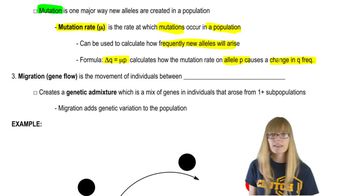
An allele is a variant form of a gene that arises by mutation and is found at the same place on a chromosome. Alleles can be dominant or recessive, influencing the expression of traits in an organism. For example, in pea plants, the allele for purple flowers is dominant over the allele for white flowers.
Recommended video:
Guided course
03:03
New Alleles and Migration

Genotype

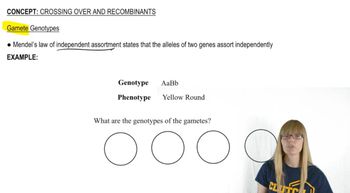
The genotype refers to the genetic constitution of an individual, specifically the alleles present at a given locus. It determines the potential traits an organism can express, although the actual expression may be influenced by environmental factors. For instance, a plant with a genotype of 'PP' or 'Pp' will exhibit purple flowers due to the presence of the dominant allele.
Recommended video:
Guided course
07:52
Gamete Genotypes

Phenotype

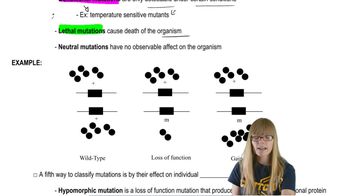
The phenotype is the observable physical or biochemical characteristics of an organism, determined by both its genotype and environmental influences. It includes traits such as flower color, height, and behavior. For example, two plants with the same genotype may have different phenotypes if they are grown in different environmental conditions.
Recommended video:
Guided course
10:48
Mutations and Phenotypes