Ch. 1 - The Molecular Basis of Heredity, Variation, and Evolution
Sanders - Genetic Analysis: An Integrated Approach 3rd Edition
Sanders3rd EditionGenetic Analysis: An Integrated ApproachISBN: 9780135564172Not the one you use?Change textbook
Chapter 1, Problem 9

What are the four processes of evolution? Briefly describe each process.

Verified step by step guidance
1
The first process of evolution is 'Mutation.' Mutations are random changes in the DNA sequence of an organism's genome. These changes can introduce new genetic variations, which may be beneficial, neutral, or harmful, and serve as the raw material for evolution.
The second process is 'Natural Selection.' This process occurs when individuals with certain heritable traits have a higher chance of survival and reproduction in a given environment. Over time, these advantageous traits become more common in the population.
The third process is 'Genetic Drift.' Genetic drift refers to random changes in allele frequencies within a population, especially in small populations. These changes are not driven by natural selection but by chance events, such as the random survival of certain individuals.
The fourth process is 'Gene Flow.' Gene flow, also known as migration, occurs when individuals from one population move to another and interbreed. This process introduces new alleles into the population, increasing genetic diversity and potentially altering allele frequencies.
Together, these four processes—mutation, natural selection, genetic drift, and gene flow—interact to drive the evolution of populations over time, shaping the genetic makeup of species.

Verified video answer for a similar problem:

This video solution was recommended by our tutors as helpful for the problem above.
Video duration:
57s
Was this helpful?

Key Concepts

Here are the essential concepts you must grasp in order to answer the question correctly.

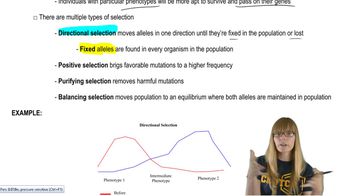
Natural Selection

Natural selection is the process by which individuals with advantageous traits are more likely to survive and reproduce. This leads to the gradual adaptation of populations to their environments. Over time, these beneficial traits become more common in the population, driving evolutionary change.
Recommended video:
Guided course
05:54
Natural Selection

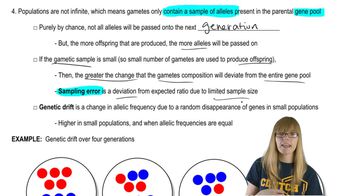
Genetic Drift

Genetic drift refers to random changes in allele frequencies within a population, which can lead to significant evolutionary changes over time, especially in small populations. This process can result in the loss of genetic diversity and can cause certain traits to become more or less common purely by chance.
Recommended video:
Guided course
10:15
Genetic Drift

Gene Flow

Gene flow, or gene migration, is the transfer of genetic material between populations through the movement of individuals or their gametes. This process can introduce new alleles into a population, increasing genetic diversity and potentially altering the evolutionary trajectory of the population.
Recommended video:
Guided course
09:09
Mapping Genes