Pearson+ LogoPearson+ Logo
Ch. 1 - The Molecular Basis of Heredity, Variation, and Evolution
Sanders - Genetic Analysis: An Integrated Approach 3rd Edition
Sanders3rd EditionGenetic Analysis: An Integrated ApproachISBN: 9780135564172Not the one you use?Change textbook
Chapter 1, Problem 8

Describe the modern synthesis of evolution, and explain how it connects Darwinian evolution to molecular evolution.

Verified step by step guidance
1
The modern synthesis of evolution is an integration of Darwin's theory of natural selection with Mendelian genetics. Begin by understanding that Darwin proposed natural selection as the mechanism for evolution, but he lacked knowledge of how traits were inherited.
Explain that Mendel's work on inheritance provided the missing piece by demonstrating that traits are passed down through discrete units (genes). This bridged the gap between Darwin's ideas and the mechanisms of heredity.
Discuss how the modern synthesis incorporates population genetics, which uses mathematical models to study how allele frequencies change over time due to factors like natural selection, genetic drift, mutation, and gene flow.
Connect this to molecular evolution by explaining that the modern synthesis also considers the molecular basis of genetic variation, such as mutations in DNA sequences, and how these variations can lead to changes in proteins and phenotypes.
Conclude by emphasizing that the modern synthesis unites Darwinian evolution (natural selection and adaptation) with molecular evolution (genetic and molecular changes), providing a comprehensive framework for understanding evolutionary processes.

Verified video answer for a similar problem:

This video solution was recommended by our tutors as helpful for the problem above.
Video duration:
2m
Was this helpful?

Key Concepts

Here are the essential concepts you must grasp in order to answer the question correctly.

Modern Synthesis

The Modern Synthesis is a comprehensive theory of evolution that integrates Darwin's natural selection with Mendelian genetics. It emphasizes that evolution occurs through changes in allele frequencies within populations over time, driven by mechanisms such as mutation, gene flow, genetic drift, and natural selection. This synthesis reconciles the observable patterns of evolution with the genetic basis of inheritance, providing a robust framework for understanding evolutionary processes.
Recommended video:
Guided course
09:03
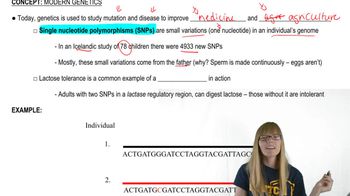
Modern Genetics

Darwinian Evolution

Darwinian evolution, based on Charles Darwin's theory, posits that species evolve through natural selection, where individuals with advantageous traits are more likely to survive and reproduce. This process leads to the gradual adaptation of populations to their environments. The Modern Synthesis builds on this foundation by incorporating genetic principles, showing how variations arise and are inherited, thus linking observable traits to genetic mechanisms.
Recommended video:

Molecular Evolution

Molecular evolution studies the processes of evolution at the molecular level, focusing on changes in DNA, RNA, and protein sequences over time. It provides insights into how genetic variations contribute to evolutionary change and the relationships between different species. By connecting molecular data with evolutionary theory, it enhances our understanding of how genetic mutations can lead to phenotypic diversity and adaptation, bridging the gap between classical evolutionary concepts and modern genetic research.
Recommended video: