Pearson+ LogoPearson+ Logo
Ch. 1 - The Molecular Basis of Heredity, Variation, and Evolution
Sanders - Genetic Analysis: An Integrated Approach 3rd Edition
Sanders3rd EditionGenetic Analysis: An Integrated ApproachISBN: 9780135564172Not the one you use?Change textbook
Chapter 1, Problem 10d

Define each of the following terms:
Translation

Verified step by step guidance
1
Translation is the process in molecular biology where the sequence of a messenger RNA (mRNA) molecule is used to synthesize a specific protein.
This process occurs in the ribosome, which is the cellular machinery responsible for protein synthesis.
During translation, transfer RNA (tRNA) molecules bring amino acids to the ribosome, matching their anticodons to the codons on the mRNA sequence.
The ribosome facilitates the formation of peptide bonds between amino acids, creating a polypeptide chain that folds into a functional protein.
Translation is the second step of gene expression, following transcription, and is essential for converting genetic information into functional proteins.

Verified video answer for a similar problem:

This video solution was recommended by our tutors as helpful for the problem above.
Video duration:
1m
Was this helpful?

Key Concepts

Here are the essential concepts you must grasp in order to answer the question correctly.

Translation

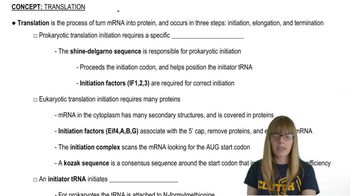
Translation is the process by which ribosomes synthesize proteins from messenger RNA (mRNA) templates. During translation, the ribosome reads the sequence of codons in the mRNA, and transfer RNA (tRNA) molecules bring the corresponding amino acids to form a polypeptide chain. This process occurs in the cytoplasm and is essential for gene expression, as proteins are crucial for cellular structure and function.
Recommended video:
Guided course
07:58
Translation initiation

Codons

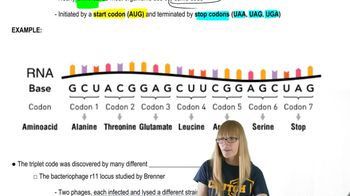
Codons are sequences of three nucleotides in mRNA that specify a particular amino acid during protein synthesis. Each codon corresponds to one of the 20 amino acids or serves as a stop signal for translation. The genetic code, which is nearly universal among organisms, dictates how sequences of nucleotides are translated into the amino acid sequences of proteins.
Recommended video:
Guided course
11:43
The Genetic Code

Ribosomes

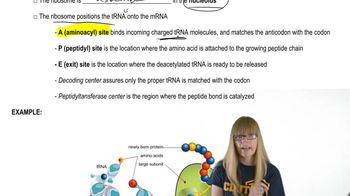
Ribosomes are complex molecular machines found within all living cells that facilitate the translation of mRNA into proteins. Composed of ribosomal RNA (rRNA) and proteins, ribosomes can be found free in the cytoplasm or attached to the endoplasmic reticulum. They play a critical role in decoding the mRNA sequence and catalyzing the formation of peptide bonds between amino acids, thus building proteins.
Recommended video:
Guided course
03:49
Ribosome Structure