How do you think the determination that DNA is the hereditary material affected the direction of biological research?
Ch. 1 - The Molecular Basis of Heredity, Variation, and Evolution

Sanders3rd EditionGenetic Analysis: An Integrated ApproachISBN: 9780135564172Not the one you use?Change textbook
All textbooks
Sanders 3rd Edition
Ch. 1 - The Molecular Basis of Heredity, Variation, and Evolution
Problem 5
Sanders 3rd Edition
Ch. 1 - The Molecular Basis of Heredity, Variation, and Evolution
Problem 5Chapter 1, Problem 5
Define the terms allele, chromosome, and gene, and explain how they relate to one another. Develop an analogy between these terms and the process of using a street map to locate a new apartment to live in next year (i.e., consider which term is analogous to a street, which to a type of building, and which to an apartment floor plan).
Verified step by step guidance1
An allele is a specific version of a gene. For example, a gene for eye color may have alleles for blue, brown, or green eyes. Think of an allele as a specific variation of a floor plan for an apartment.
A chromosome is a long, organized structure of DNA and proteins that contains many genes. It is analogous to a street, as it holds multiple buildings (genes) along its length.
A gene is a segment of DNA that codes for a specific protein or trait. It is analogous to a type of building on the street, as each building (gene) has a specific purpose or function.
The relationship between these terms can be understood as follows: chromosomes (streets) contain genes (buildings), and each gene can have different alleles (floor plans) that determine specific traits or variations.
To summarize the analogy: chromosomes are like streets, genes are like buildings on those streets, and alleles are like the specific floor plans within those buildings, each contributing to the overall layout of the neighborhood (organism's traits).

Verified video answer for a similar problem:
This video solution was recommended by our tutors as helpful for the problem above.
Video duration:
2mWas this helpful?
Key Concepts
Here are the essential concepts you must grasp in order to answer the question correctly.
Allele
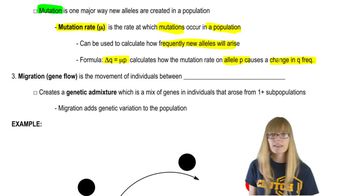
An allele is a variant form of a gene that arises by mutation and is found at the same place on a chromosome. Alleles can influence specific traits, such as eye color or blood type. In the analogy, an allele can be compared to a specific street in a neighborhood, representing a particular option or variation within a broader category.
Recommended video:
Guided course
New Alleles and Migration
Chromosome
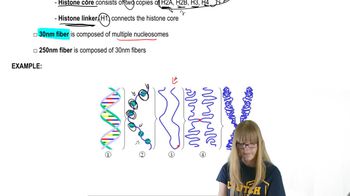
A chromosome is a long, thread-like structure composed of DNA and proteins that carries genetic information. Humans typically have 23 pairs of chromosomes, which house many genes. In the analogy, a chromosome can be likened to a street, as it provides the overall structure and organization for the genetic information, similar to how a street organizes the layout of a neighborhood.
Recommended video:
Guided course
Chromosome Structure
Gene
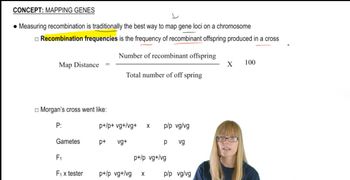
A gene is a segment of DNA that contains the instructions for building proteins, which perform various functions in the body. Genes are the basic units of heredity and can exist in different forms (alleles). In the analogy, a gene can be compared to an apartment floor plan, as it represents the specific design or instructions for a particular trait within the broader structure of the chromosome (street).
Recommended video:
Guided course
Mapping Genes
Related Practice
Textbook Question
594
views
Textbook Question
A commentator once described genetics as 'the queen of the biological sciences.' The statement was meant to imply that genetics is of overarching importance in the biological sciences. Do you agree with this statement? In what ways do you think the statement is accurate?
888
views
Textbook Question
All life shares DNA as the hereditary material. From an evolutionary perspective, why do you think this is the case?
881
views
Textbook Question
Define the terms genotype and phenotype, and relate them to one another.
852
views
Textbook Question
Define natural selection, and describe how natural selection operates as a mechanism of evolutionary change.
945
views
Textbook Question
Describe the modern synthesis of evolution, and explain how it connects Darwinian evolution to molecular evolution.
950
views