Pearson+ LogoPearson+ Logo
Ch. 1 - The Molecular Basis of Heredity, Variation, and Evolution
Sanders - Genetic Analysis: An Integrated Approach 3rd Edition
Sanders3rd EditionGenetic Analysis: An Integrated ApproachISBN: 9780135564172Not the one you use?Change textbook
Chapter 1, Problem 7

Define natural selection, and describe how natural selection operates as a mechanism of evolutionary change.

Verified step by step guidance
1
Define natural selection: Natural selection is the process by which individuals with traits that are better suited to their environment have a higher chance of surviving and reproducing. These advantageous traits are then passed on to the next generation, leading to changes in the population over time.
Explain the variation in traits: Natural selection requires genetic variation within a population. This variation arises from mutations, genetic recombination during meiosis, and other sources of genetic diversity.
Describe differential survival and reproduction: Individuals with traits that provide a survival or reproductive advantage are more likely to survive and reproduce. This is often referred to as 'survival of the fittest,' where 'fitness' refers to reproductive success.
Explain inheritance of traits: The advantageous traits that improve survival and reproduction are heritable, meaning they can be passed on to offspring. Over generations, these traits become more common in the population.
Discuss the cumulative effect: Over time, natural selection can lead to significant evolutionary changes, such as the adaptation of a species to its environment or the emergence of new species. This process is a key mechanism of evolution.

Verified video answer for a similar problem:

This video solution was recommended by our tutors as helpful for the problem above.
Video duration:
1m
Was this helpful?

Key Concepts

Here are the essential concepts you must grasp in order to answer the question correctly.

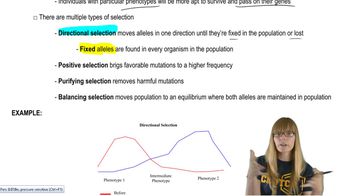
Natural Selection

Natural selection is a fundamental mechanism of evolution, proposed by Charles Darwin. It describes the process by which individuals with advantageous traits are more likely to survive and reproduce, passing those traits to the next generation. Over time, this leads to the adaptation of species to their environments.
Recommended video:
Guided course
05:54
Natural Selection

Variation and Heritability

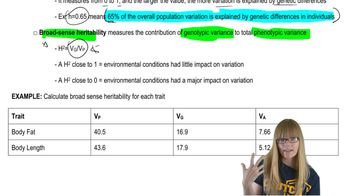
For natural selection to occur, there must be variation among individuals in a population, and these variations must be heritable. This means that traits can be passed from parents to offspring. Variations can arise from mutations, genetic recombination, and other processes, providing the raw material for natural selection to act upon.
Recommended video:
Guided course
07:04
Calculating Heritability

Survival of the Fittest

The phrase 'survival of the fittest' encapsulates the idea that individuals best suited to their environment are more likely to survive and reproduce. 'Fittest' refers not just to physical strength but to overall adaptability, including behaviors and reproductive success. This concept emphasizes the dynamic nature of populations as they respond to environmental pressures.
Recommended video:
Guided course
05:54
Natural Selection