Pearson+ LogoPearson+ Logo
Ch. 1 - The Molecular Basis of Heredity, Variation, and Evolution
Sanders - Genetic Analysis: An Integrated Approach 3rd Edition
Sanders3rd EditionGenetic Analysis: An Integrated ApproachISBN: 9780135564172Not the one you use?Change textbook
Chapter 1, Problem 15

If thymine makes up 21% of the DNA nucleotides in the genome of a plant species, what are the percentages of the other nucleotides in the genome?

Verified step by step guidance
1
span>Step 1: Understand Chargaff's rules, which state that in DNA, the amount of adenine (A) is equal to thymine (T), and the amount of cytosine (C) is equal to guanine (G).
span>Step 2: Given that thymine (T) makes up 21% of the DNA, according to Chargaff's rules, adenine (A) will also make up 21% of the DNA.
span>Step 3: Calculate the combined percentage of adenine (A) and thymine (T) in the DNA, which is 21% + 21% = 42%.
span>Step 4: Since the total percentage of all nucleotides must equal 100%, calculate the remaining percentage for cytosine (C) and guanine (G) by subtracting the combined percentage of adenine and thymine from 100%: 100% - 42% = 58%.
span>Step 5: Divide the remaining percentage equally between cytosine (C) and guanine (G), since they are present in equal amounts according to Chargaff's rules: 58% / 2 = 29% for each.

Verified video answer for a similar problem:

This video solution was recommended by our tutors as helpful for the problem above.
Video duration:
2m
Was this helpful?

Key Concepts

Here are the essential concepts you must grasp in order to answer the question correctly.

Base Pairing Rules

In DNA, the base pairing rules dictate that adenine (A) pairs with thymine (T), and cytosine (C) pairs with guanine (G). This means that the percentage of adenine in the DNA will be equal to the percentage of thymine. Therefore, if thymine constitutes 21% of the nucleotides, adenine will also make up 21%.
Recommended video:
Guided course
03:49
Base Distortions

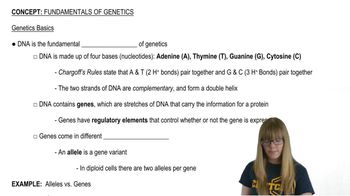
Chargaff's Rules

Chargaff's rules state that in any given DNA molecule, the amount of adenine equals thymine, and the amount of cytosine equals guanine. This principle is crucial for calculating the percentages of the other nucleotides when one nucleotide's percentage is known, as it establishes a predictable relationship between the bases.
Recommended video:
Guided course
08:44
Genetics Basics

Total Percentage of Nucleotides

The total percentage of all four nucleotides (adenine, thymine, cytosine, and guanine) in a DNA molecule must equal 100%. By knowing the percentages of adenine and thymine, one can deduce the percentages of cytosine and guanine by subtracting the known percentages from 100%, ensuring that the total adds up correctly.
Recommended video:
Guided course
09:09
Mapping Genes