Textbook Question
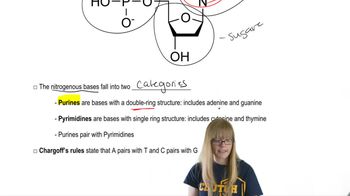
If thymine makes up 21% of the DNA nucleotides in the genome of a plant species, what are the percentages of the other nucleotides in the genome?
786
views

 Sanders 3rd EditionCh. 1 - The Molecular Basis of Heredity, Variation, and EvolutionProblem 16
 Verified step by step guidance
 06:25
06:25 06:25
06:25 04:17
04:17If thymine makes up 21% of the DNA nucleotides in the genome of a plant species, what are the percentages of the other nucleotides in the genome?
Identify two differences in chemical composition that distinguish DNA from RNA.
What is the central dogma of biology? Identify and describe the molecular processes that accomplish the flow of genetic information described in the central dogma.
A portion of a polypeptide contains the amino acids Trp-Lys-Met-Ala-Val. Write the possible mRNA and template-strand DNA sequences. (Hint: Use A/G and T/C to indicate that either adenine/guanine or thymine/cytosine could occur in a particular position, and use N to indicate that any DNA nucleotide could appear.)
Briefly describe the contribution each of the following people made to the development of genetics or genetic analysis.
Edmund B. Wilson
Briefly describe the contribution each of the following people made to the development of genetics or genetic analysis.
Rudolph Virchow