Pearson+ LogoPearson+ Logo
Ch. 1 - The Molecular Basis of Heredity, Variation, and Evolution
Sanders - Genetic Analysis: An Integrated Approach 3rd Edition
Sanders3rd EditionGenetic Analysis: An Integrated ApproachISBN: 9780135564172Not the one you use?Change textbook
Chapter 1, Problem 27

What is meant by the term homology? How is that different from the meaning of homoplasmy?

Verified step by step guidance
1
Homology refers to the similarity in DNA, RNA, or protein sequences between different organisms due to shared ancestry. For example, homologous genes in humans and mice may have similar sequences because they were inherited from a common ancestor.
Homology can be further categorized into orthologs (genes in different species that evolved from a common ancestral gene) and paralogs (genes related by duplication within a genome).
Homoplasmy, on the other hand, is a term used in mitochondrial genetics and refers to the presence of a single type of mitochondrial DNA (mtDNA) within a cell or organism. This means all copies of the mtDNA are identical.
The key difference is that homology is about evolutionary relationships and sequence similarity, while homoplasmy is about uniformity in mitochondrial DNA within a cell or organism.
Understanding these terms is important because homology helps in studying evolutionary biology, while homoplasmy is significant in understanding mitochondrial inheritance and diseases.

Verified video answer for a similar problem:

This video solution was recommended by our tutors as helpful for the problem above.
Video duration:
45s
Was this helpful?

Key Concepts

Here are the essential concepts you must grasp in order to answer the question correctly.

Homology

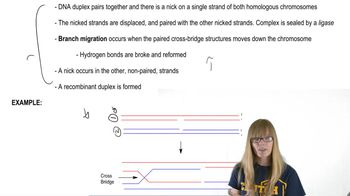
Homology refers to the similarity in structure or sequence between biological molecules, such as genes or proteins, due to shared ancestry. In genetics, homologous chromosomes are pairs of chromosomes that have the same genes at the same loci, but may have different alleles. This concept is crucial for understanding evolutionary relationships and genetic inheritance.
Recommended video:
Guided course
03:51
Recombination after Single Strand Breaks

Homoplasmy

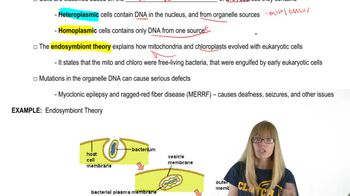
Homoplasmy describes a condition where all copies of a particular mitochondrial DNA (mtDNA) are identical within a cell or organism. This contrasts with heteroplasmy, where there is a mixture of different mtDNA sequences. Homoplasmy is significant in studies of mitochondrial inheritance and can influence traits and diseases linked to mitochondrial function.
Recommended video:
Guided course
04:11
Organelle DNA Characteristics

Genetic Variation

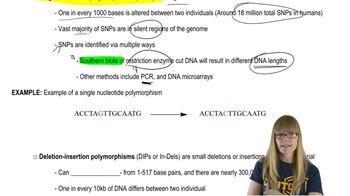
Genetic variation refers to the differences in DNA sequences among individuals within a population. This variation is essential for evolution, as it provides the raw material for natural selection. Understanding genetic variation helps clarify the distinctions between homologous traits, which arise from common ancestry, and homoplasmic traits, which may arise independently through convergent evolution.
Recommended video:
Guided course
09:28
Genomic Variation
Related Practice
Textbook Question

Suppose a genotype for a protein-producing gene can have any combination of three alleles, A₁, A₂, and A₃.

Each allele produces a protein with a distinct electrophoretic mobility. Allele A₁ has the highest electrophoretic mobility, A₃ has the lowest electrophoretic mobility, and the electrophoretic mobility of A₂ is intermediate between them. Draw the appearance of gel electrophoresis protein bands for each of the possible genotypes. Be sure to label each lane of the gel with the corresponding genotype.

645
views
Textbook Question

Shorter fragments of DNA (those with fewer base pairs) have a higher electrophoretic mobility than larger fragments. Thinking about electrophoresis gels as creating a matrix through which fragments must migrate, briefly explain why the size of a DNA fragment affects its electrophoretic mobility.

815
views
Textbook Question

Four nucleic-acid samples are analyzed to determine the percentages of the nucleotides they contain. Survey the data in the table to determine which samples are DNA and which are RNA, and specify whether each sample is double-stranded or single-stranded. Justify each answer.

[A table of nucleotide percentages appears below the problem]


1328
views
Textbook Question

If one is constructing a phylogeny of reptiles using DNA sequence data, which taxon (birds, mammals, amphibians, or fish) might be suitable to use as an outgroup?

1377
views
Textbook Question

Consider the following segment of DNA:

    5'-...ATGCCAGTCACTGACTTG...-3'

    3'-...TACGGTCAGTGACTGAAC...-5'

How many phosphodiester bonds are required to form this segment of double-stranded DNA?

577
views
Textbook Question

Consider the following segment of DNA:

    5'-...ATGCCAGTCACTGACTTG...-3'

    3'-...TACGGTCAGTGACTGAAC...-5'

How many hydrogen bonds are present in this DNA segment?

538
views