Pearson+ LogoPearson+ Logo
Ch. 10 - Eukaryotic Chromosome Abnormalities and Molecular Organization
Sanders - Genetic Analysis: An Integrated Approach 3rd Edition
Sanders3rd EditionGenetic Analysis: An Integrated ApproachISBN: 9780135564172Not the one you use?Change textbook
Chapter 10, Problem 5

Human late prophase karyotypes have about 2000 visible G bands. The human genome contains approximately 22,000 genes. Consider the region 5p1.5 through the end of the short arm of chromosome 5, which is identified on the late prophase chromosome in Figure 10.5, and assume the entire region is deleted. Approximately how many genes will be lost as a result of the deletion?

Verified step by step guidance
1
Identify the total number of G bands in a human late prophase karyotype, which is approximately 2000.
Determine the total number of genes in the human genome, which is approximately 22,000.
Understand that the G bands are used as a reference to estimate the number of genes in a specific chromosomal region.
Calculate the proportion of the chromosome that the region 5p1.5 through the end of the short arm of chromosome 5 represents in terms of G bands.
Estimate the number of genes in the deleted region by applying the proportion of G bands to the total number of genes in the human genome.

Verified video answer for a similar problem:

This video solution was recommended by our tutors as helpful for the problem above.
Video duration:
1m
Was this helpful?

Key Concepts

Here are the essential concepts you must grasp in order to answer the question correctly.

Karyotype and G-banding

A karyotype is a visual representation of an individual's chromosomes, organized by size and shape. G-banding is a technique used to stain chromosomes, producing a pattern of light and dark bands that helps identify specific chromosomes and their structural features. In humans, there are about 2000 visible G bands, which correspond to regions of DNA that can be analyzed for genetic abnormalities.
Recommended video:
Guided course
06:25
DNA Structure

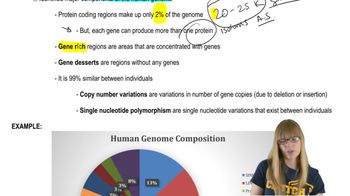
Human Genome and Gene Count

The human genome is the complete set of genetic information for humans, consisting of approximately 22,000 genes. These genes are segments of DNA that encode instructions for building proteins, which perform various functions in the body. Understanding the distribution of genes across chromosomes is crucial for assessing the impact of genetic deletions or mutations.
Recommended video:
Guided course
06:51
Human Genome Composition

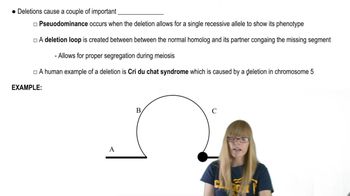
Chromosomal Deletion

A chromosomal deletion is a type of genetic mutation where a segment of DNA is lost from a chromosome. This can lead to the loss of one or more genes, potentially resulting in various genetic disorders or phenotypic changes. In the context of the question, deleting the region 5p1.5 through the end of chromosome 5 would remove all genes located within that specific segment, affecting the overall gene count.
Recommended video: