Pearson+ LogoPearson+ Logo
Ch. 11 - Gene Mutation, DNA Repair, and Homologous Recombination
Sanders - Genetic Analysis: An Integrated Approach 3rd Edition
Sanders3rd EditionGenetic Analysis: An Integrated ApproachISBN: 9780135564172Not the one you use?Change textbook
Chapter 11, Problem 8

The effect of base-pair substitution mutations on protein function varies widely from no detectable effect to the complete loss of protein function (null allele). Why do the functional consequences of base-pair substitution vary so widely?

Verified step by step guidance
1
Base-pair substitution mutations involve the replacement of one nucleotide base with another in the DNA sequence.
The effect of such mutations on protein function depends on several factors, including the location of the mutation within the gene and the nature of the amino acid change.
If the substitution occurs in a non-coding region or results in a synonymous codon (silent mutation), it may have no effect on the protein function.
If the substitution leads to a missense mutation, where one amino acid is replaced by another, the effect on protein function can vary depending on the properties of the amino acids involved and their role in the protein's structure and function.
A nonsense mutation, where a codon is changed to a stop codon, can lead to a truncated protein, often resulting in a loss of function.

Verified video answer for a similar problem:

This video solution was recommended by our tutors as helpful for the problem above.
Video duration:
2m
Was this helpful?

Key Concepts

Here are the essential concepts you must grasp in order to answer the question correctly.

Base-Pair Substitution Mutations

Base-pair substitution mutations occur when one nucleotide in the DNA sequence is replaced by another. This can lead to changes in the corresponding amino acid in a protein, potentially altering its structure and function. Depending on the location and nature of the substitution, these mutations can have varying effects, from benign to detrimental.
Recommended video:
Guided course
03:49
Base Distortions

Protein Structure and Function

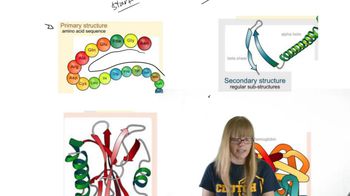
Proteins are composed of amino acids arranged in specific sequences, which determine their three-dimensional structure and function. A change in a single amino acid due to a base-pair substitution can disrupt the protein's folding or active site, affecting its ability to perform its biological role. The relationship between structure and function is critical in understanding the impact of mutations.
Recommended video:

Phenotypic Consequences of Mutations

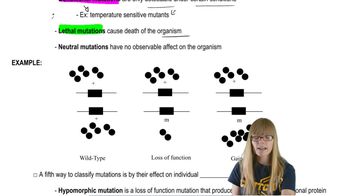
The phenotypic consequences of mutations can vary widely based on several factors, including the type of mutation, the gene affected, and the organism's overall genetic context. Some mutations may be silent, causing no observable change, while others can lead to a complete loss of function (null alleles) or gain of new functions. This variability is influenced by the redundancy of the genetic code and the specific roles of the affected proteins.
Recommended video:
Guided course
10:48
Mutations and Phenotypes
Related Practice
Textbook Question

Ultraviolet (UV) radiation is mutagenic.

Identify and describe two DNA repair mechanisms that remove UV-induced DNA lesions.

627
views
Textbook Question

Researchers interested in studying mutation and mutation repair often induce mutations with various agents. What kinds of gene mutations are induced by

Chemical mutagens? Give two examples.

381
views
Textbook Question

Researchers interested in studying mutation and mutation repair often induce mutations with various agents. What kinds of gene mutations are induced by

Radiation energy? Give two examples.

428
views
Textbook Question

Describe the purpose of the Ames test. How are his⁻ bacteria used in the Ames test? What mutational event is identified using his⁻ bacteria?

602
views
Textbook Question

In numerous population studies of spontaneous mutation, two observations are made consistently: (1) Most mutations are recessive, and (2) forward mutation is more frequent than reversion. What do you think are the likely explanations for these two observations?

512
views
Textbook Question

Two different mutations are identified in a haploid strain of yeast. The first prevents the synthesis of adenine by a nonsense mutation of the ade-1 gene. In this mutation, a base-pair substitution changes a tryptophan codon (UGG) to a stop codon (UGA). The second affects one of several duplicate tRNA genes. This base-pair substitution mutation changes the anticodon sequence of a tRNAᵀʳᵖ from


   3′−ACC−5′ to 3′−ACU−5′


Do you consider the first mutation to be a forward mutation or a reversion? Why?

469
views