Pearson+ LogoPearson+ Logo
Ch. 12 - Regulation of Gene Expression in Bacteria and Bacteriophage
Sanders - Genetic Analysis: An Integrated Approach 3rd Edition
Sanders3rd EditionGenetic Analysis: An Integrated ApproachISBN: 9780135564172Not the one you use?Change textbook
Chapter 12, Problem 12

Consider the transcription of genes of the lac operon under two conditions: (1) when both glucose and lactose are present and (2) when glucose is absent and lactose is present. Describe the comparative levels of transcription of lac operon genes under these conditions, and explain the molecular basis for the difference.

Verified step by step guidance
1
Understand the lac operon: The lac operon in E. coli is a set of genes responsible for the metabolism of lactose. It is regulated by the availability of glucose and lactose in the environment. The operon includes structural genes (lacZ, lacY, lacA), a promoter, an operator, and a regulatory gene (lacI).
Condition 1: When both glucose and lactose are present, transcription of the lac operon is low. This is due to catabolite repression, where the presence of glucose inhibits the activity of adenylate cyclase, leading to low levels of cyclic AMP (cAMP). Without sufficient cAMP, the cAMP-CRP (cAMP receptor protein) complex cannot form, which is necessary for enhancing RNA polymerase binding to the promoter.
Condition 2: When glucose is absent and lactose is present, transcription of the lac operon is high. In the absence of glucose, adenylate cyclase is active, producing high levels of cAMP. The cAMP binds to CRP, forming the cAMP-CRP complex, which binds to the promoter region of the lac operon and facilitates RNA polymerase binding, leading to increased transcription.
Explain the role of lactose: Lactose acts as an inducer by binding to the repressor protein (produced by the lacI gene), causing a conformational change that prevents the repressor from binding to the operator. This allows RNA polymerase to access the promoter and initiate transcription, provided the cAMP-CRP complex is present.
Summarize the molecular basis for the difference: The difference in transcription levels under the two conditions is due to the combined effects of catabolite repression (regulated by glucose levels) and induction (regulated by lactose levels). High transcription occurs only when glucose is absent (allowing cAMP-CRP complex formation) and lactose is present (inactivating the repressor).

Verified video answer for a similar problem:

This video solution was recommended by our tutors as helpful for the problem above.
Video duration:
2m
Was this helpful?

Key Concepts

Here are the essential concepts you must grasp in order to answer the question correctly.

Lac Operon Structure and Function

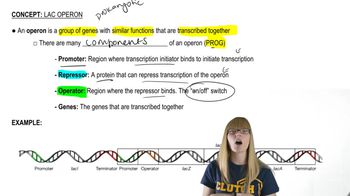
The lac operon is a set of genes in E. coli that are involved in the metabolism of lactose. It consists of three structural genes (lacZ, lacY, and lacA) and regulatory elements that control their expression. The operon is activated in the presence of lactose and repressed when glucose is available, illustrating the concept of gene regulation in response to environmental conditions.
Recommended video:
Guided course
04:27
Lac Operon Overview

Catabolite Repression

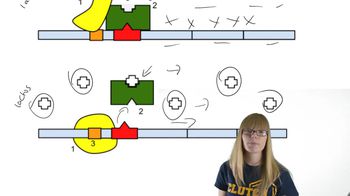
Catabolite repression is a regulatory mechanism that prioritizes the use of glucose over other sugars, such as lactose. When glucose is present, it inhibits the production of cyclic AMP (cAMP), which is necessary for the activation of the lac operon. This results in low transcription levels of the lac genes when glucose is available, even if lactose is present.
Recommended video:
Guided course
06:55
Lac Operon Regulation

cAMP and CAP Interaction

Cyclic AMP (cAMP) binds to the catabolite activator protein (CAP), forming a complex that enhances the transcription of the lac operon. In the absence of glucose, cAMP levels rise, allowing the cAMP-CAP complex to bind to the promoter region of the lac operon, facilitating RNA polymerase binding and increasing transcription levels. This interaction is crucial for the operon's activation when lactose is the primary energy source.
Recommended video:
Guided course
07:56
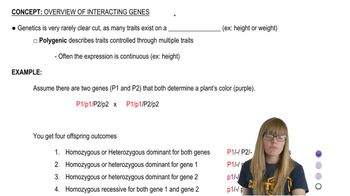
Interacting Genes Overview