Pearson+ LogoPearson+ Logo
Ch. 12 - Regulation of Gene Expression in Bacteria and Bacteriophage
Sanders - Genetic Analysis: An Integrated Approach 3rd Edition
Sanders3rd EditionGenetic Analysis: An Integrated ApproachISBN: 9780135564172Not the one you use?Change textbook
Chapter 12, Problem 14

Define antisense RNA, and describe how it affects the translation of a complementary mRNA. Why is it more advantageous to the organism to stop translation initiation than to inactivate or destroy the gene product after it is produced?

Verified step by step guidance
1
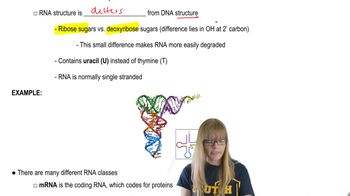
Antisense RNA is a single-stranded RNA molecule that is complementary to a specific mRNA strand. It binds to the mRNA through base pairing, forming a double-stranded RNA structure.
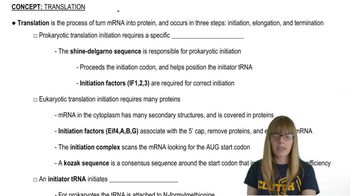
When antisense RNA binds to its complementary mRNA, it prevents the ribosome from accessing the mRNA. This blocks translation initiation, effectively stopping the production of the corresponding protein.
Stopping translation initiation using antisense RNA is advantageous because it conserves cellular resources. Producing a protein requires energy and raw materials, so preventing its synthesis avoids unnecessary expenditure.
Inactivating or destroying the gene product after it is produced is less efficient because the cell has already invested energy and resources into synthesizing the protein. This approach also requires additional mechanisms to degrade or modify the protein, which can further strain cellular resources.
By using antisense RNA to block translation initiation, the organism can regulate gene expression more precisely and efficiently, ensuring that proteins are only produced when needed and avoiding wasteful production.

Verified video answer for a similar problem:

This video solution was recommended by our tutors as helpful for the problem above.
Video duration:
2m
Was this helpful?

Key Concepts

Here are the essential concepts you must grasp in order to answer the question correctly.

Antisense RNA

Antisense RNA is a strand of RNA that is complementary to a specific mRNA molecule. It binds to the mRNA, forming a double-stranded RNA complex that prevents the mRNA from being translated into a protein. This mechanism is a form of gene regulation, allowing cells to control protein synthesis in response to various signals.
Recommended video:

Translation Inhibition

Translation inhibition refers to the process of preventing the synthesis of proteins from mRNA. Antisense RNA achieves this by binding to the target mRNA, blocking ribosome access and thus halting translation initiation. This is crucial for regulating gene expression and ensuring that proteins are produced only when needed.
Recommended video:
Guided course
07:58
Translation initiation

Advantages of Stopping Translation Initiation

Stopping translation initiation is often more advantageous than inactivating or destroying a gene product because it allows for a rapid response to changing cellular conditions. By preventing the production of unnecessary proteins, the organism conserves energy and resources. Additionally, this method avoids the potential accumulation of misfolded or harmful proteins that could occur if the gene product were produced and then inactivated.
Recommended video:
Guided course
07:58
Translation initiation
Related Practice
Textbook Question

Explain the circumstances under which attenuation of operon gene expression is advantageous to a bacterial organism. Would you expect attenuation to be found in a single-celled eukaryote? In a multicelled eukaryote?

509
views
Textbook Question

Consider the transcription of genes of the lac operon under two conditions: (1) when both glucose and lactose are present and (2) when glucose is absent and lactose is present. Describe the comparative levels of transcription of lac operon genes under these conditions, and explain the molecular basis for the difference.

809
views
Textbook Question

Describe the lytic and lysogenic life cycles of λ bacteriophage. What roles do λ repressor and Cro protein play in controlling transcription from PR and PRM, and how are these roles linked to lysis and lysogeny?

643
views
Textbook Question

Attenuation of trp operon transcription is controlled by the formation of stem-loop structures in mRNA. The attenuation function can be disrupted by mutations that alter the sequence of repeat DNA regions 1 to 4 and prevent the formation of mRNA stem loops. Describe the likely effects on attenuation of each of the following mutations under the conditions specified.

1286
views
Textbook Question

In the lac operon, what are the likely effects on operon gene transcription of the mutations described in a–e?

Mutation of consensus sequence in the lac promoter

874
views
Textbook Question

In the lac operon, what are the likely effects on operon gene transcription of the mutations described in a–e?

Mutation of the repressor binding site on the operator sequence

560
views