Pearson+ LogoPearson+ Logo
Ch. 12 - Regulation of Gene Expression in Bacteria and Bacteriophage
Sanders - Genetic Analysis: An Integrated Approach 3rd Edition
Sanders3rd EditionGenetic Analysis: An Integrated ApproachISBN: 9780135564172Not the one you use?Change textbook
Chapter 12, Problem 13

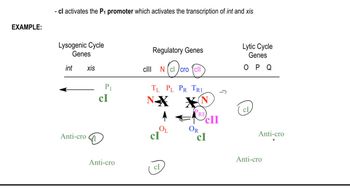
Describe the lytic and lysogenic life cycles of λ bacteriophage. What roles do λ repressor and Cro protein play in controlling transcription from PR and PRM, and how are these roles linked to lysis and lysogeny?

Verified step by step guidance
1
Understand the two life cycles of λ bacteriophage: The lytic cycle involves the virus replicating and lysing the host cell to release new phages, while the lysogenic cycle integrates the phage DNA into the host genome, allowing it to replicate passively with the host cell without causing immediate harm.
Explain the role of the λ repressor (also called CI protein): The λ repressor binds to the operator regions OL and OR, blocking transcription from the lytic promoters PL and PR. This repression ensures the virus enters and maintains the lysogenic cycle by preventing the expression of genes required for lysis.
Explain the role of the Cro protein: Cro protein binds to the same operator regions as the λ repressor but with different affinities. It represses transcription from PRM (the promoter for the λ repressor) and promotes transcription from PL and PR, favoring the lytic cycle by allowing the expression of lytic genes.
Describe the competition between λ repressor and Cro protein: The balance between these two proteins determines the life cycle. High levels of λ repressor maintain lysogeny by repressing lytic genes, while high levels of Cro protein shift the balance toward the lytic cycle by repressing the λ repressor and activating lytic genes.
Link the roles of PM and PRM to the life cycles: PM (maintenance promoter) is responsible for the continued expression of the λ repressor during lysogeny, while PRM (repressor maintenance promoter) is activated to produce more λ repressor. Cro protein inhibits PRM, tipping the balance toward lysis. This regulatory network ensures the phage can switch between cycles based on environmental conditions.

Verified video answer for a similar problem:

This video solution was recommended by our tutors as helpful for the problem above.
Video duration:
3m
Was this helpful?

Key Concepts

Here are the essential concepts you must grasp in order to answer the question correctly.

Lytic and Lysogenic Life Cycles

The lytic cycle is a viral reproductive process where the virus infects a host cell, replicates its genetic material, and ultimately causes the cell to lyse, releasing new virions. In contrast, the lysogenic cycle involves the integration of the viral genome into the host's DNA, allowing it to replicate along with the host cell without causing immediate harm. This cycle can switch to the lytic phase under certain conditions, leading to cell lysis.
Recommended video:
Guided course
08:04
Decision Between Lytic and Lysogenic Cycles

λ Repressor and Cro Protein

The λ repressor is a protein that maintains the lysogenic state by binding to specific DNA sites, inhibiting the expression of genes necessary for the lytic cycle. Conversely, Cro protein promotes the lytic cycle by repressing the expression of the λ repressor. The balance between these two proteins determines whether the bacteriophage will enter the lytic or lysogenic cycle, influencing the fate of the host cell.
Recommended video:

Transcription Control from PM and PRM

PM and PRM are promoters that regulate the transcription of genes involved in the lytic and lysogenic cycles. PM drives the expression of genes necessary for the lytic cycle, while PRM is responsible for the maintenance of the lysogenic state by promoting λ repressor production. The interplay between these promoters, influenced by the levels of λ repressor and Cro protein, is crucial for determining whether the bacteriophage will undergo lysis or establish lysogeny.
Recommended video:
Guided course
09:16
Eukaryotic Transcription
Related Practice
Textbook Question

How would a cap⁻ mutation that produces an inactive CAP protein affect transcriptional control of the lac operon?

716
views
Textbook Question

Explain the circumstances under which attenuation of operon gene expression is advantageous to a bacterial organism. Would you expect attenuation to be found in a single-celled eukaryote? In a multicelled eukaryote?

509
views
Textbook Question

Consider the transcription of genes of the lac operon under two conditions: (1) when both glucose and lactose are present and (2) when glucose is absent and lactose is present. Describe the comparative levels of transcription of lac operon genes under these conditions, and explain the molecular basis for the difference.

809
views
Textbook Question

Define antisense RNA, and describe how it affects the translation of a complementary mRNA. Why is it more advantageous to the organism to stop translation initiation than to inactivate or destroy the gene product after it is produced?

1092
views
Textbook Question

Attenuation of trp operon transcription is controlled by the formation of stem-loop structures in mRNA. The attenuation function can be disrupted by mutations that alter the sequence of repeat DNA regions 1 to 4 and prevent the formation of mRNA stem loops. Describe the likely effects on attenuation of each of the following mutations under the conditions specified.

1286
views
Textbook Question

In the lac operon, what are the likely effects on operon gene transcription of the mutations described in a–e?

Mutation of consensus sequence in the lac promoter

874
views