Pearson+ LogoPearson+ Logo
Ch. 12 - Regulation of Gene Expression in Bacteria and Bacteriophage
Sanders - Genetic Analysis: An Integrated Approach 3rd Edition
Sanders3rd EditionGenetic Analysis: An Integrated ApproachISBN: 9780135564172Not the one you use?Change textbook
Chapter 12, Problem 28b

How would mutations that inactivate each of the following genes affect the determination of the lytic or lysogenic life cycle in mutated λ phage strains? Explain your answers.
cII

Verified step by step guidance
1
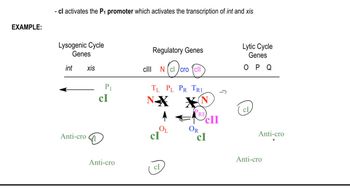
Understand the role of the cII gene: The cII gene in λ phage encodes a transcriptional activator protein that is crucial for the lysogenic pathway. It activates the transcription of the cI gene (which encodes the λ repressor) and the int gene (which is involved in integrating the phage DNA into the host genome).
Consider the effect of a mutation that inactivates cII: If the cII gene is inactivated, the cII protein will not be produced. Without cII, the transcription of the cI gene and the int gene will not be efficiently activated.
Analyze the impact on the lysogenic pathway: The absence of cI transcription means that the λ repressor protein, which is necessary to establish and maintain the lysogenic state, will not be produced. Additionally, the lack of int gene activation will prevent the integration of phage DNA into the host genome.
Determine the effect on the lytic pathway: Without the establishment of the lysogenic state, the phage is more likely to default to the lytic pathway. In the lytic pathway, the phage replicates its DNA and produces new phage particles, ultimately lysing the host cell.
Conclude the outcome: A mutation that inactivates the cII gene would likely result in the phage being unable to enter the lysogenic cycle and instead favor the lytic cycle, as the necessary components for lysogeny are not produced.

Verified video answer for a similar problem:

This video solution was recommended by our tutors as helpful for the problem above.
Video duration:
3m
Was this helpful?

Key Concepts

Here are the essential concepts you must grasp in order to answer the question correctly.

Lytic and Lysogenic Cycles

The lytic and lysogenic cycles are two distinct pathways that bacteriophages, like λ phage, can follow after infecting a bacterial cell. In the lytic cycle, the phage replicates rapidly, leading to the destruction of the host cell and the release of new phage particles. In contrast, the lysogenic cycle involves the integration of the phage DNA into the host genome, allowing it to replicate along with the host cell without causing immediate harm.
Recommended video:
Guided course
08:04
Decision Between Lytic and Lysogenic Cycles

cII Gene Function

The cII gene of λ phage plays a crucial role in determining the life cycle of the phage. It is involved in promoting the lysogenic cycle by stabilizing the expression of genes that lead to the integration of phage DNA into the host genome. When cII is active, it favors lysogeny; however, if cII is inactivated by mutations, the phage is more likely to enter the lytic cycle, as the regulatory balance shifts.
Recommended video:
Guided course
08:26
Functional Genomics

Mutations and Gene Inactivation

Mutations are changes in the DNA sequence that can lead to the inactivation of genes, affecting their normal function. In the context of the cII gene, mutations that inactivate it would disrupt the regulatory mechanisms that favor lysogeny, potentially resulting in a higher propensity for the phage to undergo the lytic cycle. Understanding how specific mutations impact gene function is essential for predicting the behavior of phage strains.
Recommended video:
Guided course
09:30
X-Inactivation