Pearson+ LogoPearson+ Logo
Ch. 12 - Regulation of Gene Expression in Bacteria and Bacteriophage
Sanders - Genetic Analysis: An Integrated Approach 3rd Edition
Sanders3rd EditionGenetic Analysis: An Integrated ApproachISBN: 9780135564172Not the one you use?Change textbook
Chapter 12, Problem 2g

Transcriptional regulation of operon gene expression involves the interaction of molecules with one another and of regulatory molecules with segments of DNA. In this context, define and give an example of each of the following:
Allostery

Verified step by step guidance
1
Define allostery: Allostery refers to the regulation of a protein's activity through the binding of a molecule at a site other than the protein's active site. This binding induces a conformational change in the protein, which can either enhance or inhibit its function.
Explain the role of allostery in transcriptional regulation: In the context of gene expression, allostery often involves regulatory proteins, such as repressors or activators, whose ability to bind DNA is influenced by the binding of small molecules (effectors) at allosteric sites.
Provide an example: A classic example of allostery is the lac repressor in the lac operon of *E. coli*. The lac repressor binds to the operator region of the operon to block transcription. However, when allolactose (an inducer molecule) binds to the repressor at its allosteric site, it causes a conformational change that reduces the repressor's affinity for the operator, allowing transcription to proceed.
Describe the molecular mechanism: The binding of the effector molecule (e.g., allolactose) to the allosteric site alters the shape of the regulatory protein. This change in shape can either increase or decrease the protein's ability to interact with DNA or other molecules involved in transcriptional regulation.
Summarize the importance: Allostery is a key mechanism in the regulation of gene expression, allowing cells to respond dynamically to changes in their environment by modulating the activity of regulatory proteins.

Verified video answer for a similar problem:

This video solution was recommended by our tutors as helpful for the problem above.
Video duration:
4m
Was this helpful?

Key Concepts

Here are the essential concepts you must grasp in order to answer the question correctly.

Allostery

Allostery refers to the regulation of a protein's function through the binding of an effector molecule at a site other than the protein's active site. This binding induces a conformational change in the protein, altering its activity. For example, in the case of hemoglobin, the binding of oxygen to one subunit increases the affinity of the remaining subunits for oxygen, demonstrating how allosteric interactions can enhance or inhibit protein function.

Operon

An operon is a cluster of genes under the control of a single promoter, which are transcribed together as a single mRNA molecule. Operons are a key feature in prokaryotic gene regulation, allowing coordinated expression of genes that encode proteins with related functions. The lac operon in E. coli, which regulates the metabolism of lactose, is a classic example, where the presence of lactose induces the expression of genes necessary for its utilization.
Recommended video:
Guided course
03:45
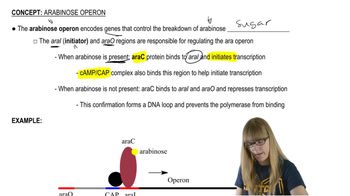
Arabinose Operon

Transcriptional Regulation

Transcriptional regulation involves the mechanisms that control the transcription of genes, determining when and how much of a gene product is produced. This regulation can occur through various factors, including transcription factors that bind to specific DNA sequences, enhancers, and silencers. For instance, in the presence of glucose, the lac operon is repressed, demonstrating how environmental conditions can influence gene expression through transcriptional regulation.
Recommended video:
Guided course
09:16
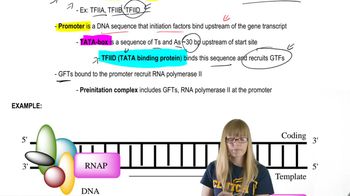
Eukaryotic Transcription
Related Practice
Textbook Question

Transcriptional regulation of operon gene expression involves the interaction of molecules with one another and of regulatory molecules with segments of DNA. In this context, define and give an example of each of the following:

Corepressor

551
views
Textbook Question

Transcriptional regulation of operon gene expression involves the interaction of molecules with one another and of regulatory molecules with segments of DNA. In this context, define and give an example of each of the following:

Promoter

561
views
Textbook Question

Transcriptional regulation of operon gene expression involves the interaction of molecules with one another and of regulatory molecules with segments of DNA. In this context, define and give an example of each of the following:

Positive regulation

716
views
Textbook Question

Transcriptional regulation of operon gene expression involves the interaction of molecules with one another and of regulatory molecules with segments of DNA. In this context, define and give an example of each of the following:

Negative regulation

550
views
Textbook Question

Transcriptional regulation of operon gene expression involves the interaction of molecules with one another and of regulatory molecules with segments of DNA. In this context, define and give an example of each of the following:

Attenuation

517
views
Textbook Question
Why is it essential that bacterial cells be able to regulate the expression of their genes? What are the energetic and evolutionary advantages of regulated gene expression? Is the expression of all bacterial genes subject to regulated expression? Compare and contrast the difference between regulated gene expression and constitutive gene expression.
982
views