Pearson+ LogoPearson+ Logo
Ch. 12 - Regulation of Gene Expression in Bacteria and Bacteriophage
Sanders - Genetic Analysis: An Integrated Approach 3rd Edition
Sanders3rd EditionGenetic Analysis: An Integrated ApproachISBN: 9780135564172Not the one you use?Change textbook
Chapter 12, Problem 2i

Transcriptional regulation of operon gene expression involves the interaction of molecules with one another and of regulatory molecules with segments of DNA. In this context, define and give an example of each of the following:
Attenuation

Verified step by step guidance
1
Define attenuation: Attenuation is a regulatory mechanism in prokaryotes, particularly in operons like the trp operon, where transcription is prematurely terminated based on the interaction between transcription and translation processes.
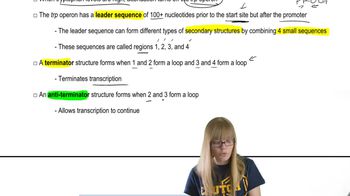
Explain the mechanism: Attenuation relies on the formation of specific secondary structures in the mRNA transcript, such as stem-loop structures, which can either terminate transcription or allow it to continue.
Provide an example: In the trp operon of *E. coli*, when tryptophan levels are high, a leader peptide is translated, causing the formation of a terminator stem-loop in the mRNA. This terminator structure halts transcription before the structural genes of the operon are transcribed.
Contrast with low tryptophan levels: When tryptophan levels are low, the ribosome stalls during translation of the leader peptide due to a lack of charged tRNA^Trp. This allows the formation of an anti-terminator stem-loop, enabling transcription of the structural genes.
Summarize the importance: Attenuation provides a fine-tuned mechanism for regulating gene expression in response to metabolite levels, ensuring that resources are conserved when the end product (e.g., tryptophan) is abundant.

Verified video answer for a similar problem:

This video solution was recommended by our tutors as helpful for the problem above.
Video duration:
2m
Was this helpful?

Key Concepts

Here are the essential concepts you must grasp in order to answer the question correctly.

Attenuation

Attenuation is a regulatory mechanism in prokaryotic gene expression that controls transcription termination. It occurs in operons, where the formation of specific RNA structures in the leader region of mRNA can either promote or inhibit the continuation of transcription based on the presence of certain metabolites. For example, in the tryptophan operon, high levels of tryptophan lead to the formation of a hairpin structure that causes RNA polymerase to terminate transcription prematurely.
Recommended video:
Guided course
09:11
Trp Attenuation

Operon

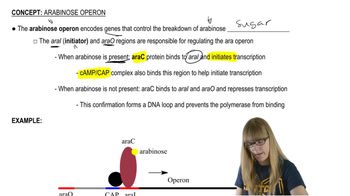
An operon is a cluster of genes under the control of a single promoter, allowing for coordinated expression of genes that often encode proteins with related functions. In prokaryotes, operons enable efficient regulation of gene expression in response to environmental changes. The classic example is the lac operon, which is involved in lactose metabolism and is activated in the presence of lactose while being repressed in its absence.
Recommended video:
Guided course
03:45
Arabinose Operon

Transcriptional Regulation

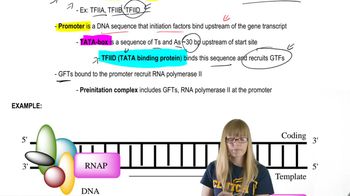
Transcriptional regulation refers to the mechanisms that control the rate and timing of gene transcription, ensuring that genes are expressed at the right levels and times. This regulation can involve various factors, including transcription factors, enhancers, silencers, and regulatory RNAs. In the context of operons, transcriptional regulation allows cells to respond quickly to changes in their environment, such as nutrient availability.
Recommended video:
Guided course
09:16
Eukaryotic Transcription
Related Practice
Textbook Question

Transcriptional regulation of operon gene expression involves the interaction of molecules with one another and of regulatory molecules with segments of DNA. In this context, define and give an example of each of the following:

Positive regulation

716
views
Textbook Question

Transcriptional regulation of operon gene expression involves the interaction of molecules with one another and of regulatory molecules with segments of DNA. In this context, define and give an example of each of the following:

Allostery

673
views
Textbook Question

Transcriptional regulation of operon gene expression involves the interaction of molecules with one another and of regulatory molecules with segments of DNA. In this context, define and give an example of each of the following:

Negative regulation

550
views
Textbook Question
Why is it essential that bacterial cells be able to regulate the expression of their genes? What are the energetic and evolutionary advantages of regulated gene expression? Is the expression of all bacterial genes subject to regulated expression? Compare and contrast the difference between regulated gene expression and constitutive gene expression.
982
views
Textbook Question

Identify similarities and differences between an inducible operon and a repressible operon in terms of

The transcription-regulating DNA sequences.

791
views
Textbook Question

Identify similarities and differences between an inducible operon and a repressible operon in terms of

The presence and action of allosteric regulatory molecules.

566
views