Pearson+ LogoPearson+ Logo
Ch. 14 - Analysis of Gene Function via Forward Genetics and Reverse Genetics
Sanders - Genetic Analysis: An Integrated Approach 3rd Edition
Sanders3rd EditionGenetic Analysis: An Integrated ApproachISBN: 9780135564172Not the one you use?Change textbook
Chapter 14, Problem C.4b

Explain the following processes involving chromosome mutations and cancer development.
How the chromosome mutation producing Burkitt lymphoma generates the disease.

Verified step by step guidance
1
Understand that Burkitt lymphoma is a type of cancer caused by a specific chromosomal mutation known as a translocation, which involves the exchange of genetic material between chromosomes.
Identify the chromosomes involved in Burkitt lymphoma, typically a translocation between chromosome 8 and chromosome 14, denoted as t(8;14).
Recognize that this translocation places the MYC gene from chromosome 8 next to the immunoglobulin heavy chain gene on chromosome 14, leading to overexpression of the MYC oncogene.
Explain that the overexpression of the MYC gene causes uncontrolled cell division and proliferation, which is a hallmark of cancer development, specifically leading to the formation of Burkitt lymphoma.
Summarize that the chromosomal mutation disrupts normal gene regulation, turning a proto-oncogene into an oncogene, thereby driving the malignant transformation of B cells in the lymphatic system.

Verified video answer for a similar problem:

This video solution was recommended by our tutors as helpful for the problem above.
Video duration:
2m
Was this helpful?

Key Concepts

Here are the essential concepts you must grasp in order to answer the question correctly.

Chromosome Mutations

Chromosome mutations involve structural changes in chromosomes, such as translocations, deletions, or duplications. These alterations can disrupt gene function or regulation, potentially leading to abnormal cell behavior. Understanding these mutations is essential to grasp how genetic changes contribute to diseases like cancer.
Recommended video:
Guided course
10:48
Mutations and Phenotypes

Burkitt Lymphoma and Chromosomal Translocation

Burkitt lymphoma is caused by a specific chromosomal translocation, typically t(8;14), which moves the MYC oncogene next to the immunoglobulin heavy chain gene. This translocation leads to overexpression of MYC, a gene that promotes cell proliferation, driving uncontrolled growth of B cells and resulting in lymphoma.
Recommended video:
Guided course
12:42
Reciprocal Translocation

Oncogenes and Cancer Development

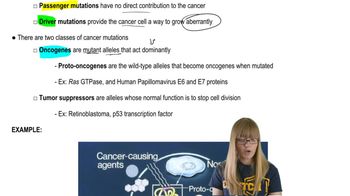
Oncogenes are mutated or abnormally expressed genes that drive cancer progression by promoting cell division and survival. When chromosome mutations activate oncogenes like MYC, they disrupt normal cell cycle control, leading to unchecked cell growth and tumor formation, as seen in cancers such as Burkitt lymphoma.
Recommended video:
Guided course
04:46
Cancer Mutations
Related Practice
Textbook Question

Go to the website http://www.ncbi.nlm.nih.gov/omim and enter 'Lynch syndrome' in the Search box at the top of the page. From the list of options given, select '#120435—Lynch Syndrome.' Use the information you retrieve to answer the following questions. What genes are most commonly mutated in Lynch syndrome?

501
views
Textbook Question

Go to the website http://www.ncbi.nlm.nih.gov/omim and enter 'Lynch syndrome' in the Search box at the top of the page. From the list of options given, select '#120435—Lynch Syndrome.' Use the information you retrieve to answer the following questions. Provide a brief summary of the normal functions of the protein products of these genes.

386
views
Textbook Question

Go to the website http://www.ncbi.nlm.nih.gov/omim and enter 'Lynch syndrome' in the Search box at the top of the page. From the list of options given, select '#120435—Lynch Syndrome.' Use the information you retrieve to answer the following questions. What are the approximate rates of cancer that develop in people carrying a mutation of one of these genes?

544
views
Textbook Question

Go to the website http://www.cancer.gov and select 'Cancer Types' on the top menu bar. Scroll down to 'Breast Cancer' and click. Select 'Cases & Prevention' from the options. Click 'More information' and select 'BRCA Mutations: Cancer Risk and Genetic Testing'. Use the information on this page to answer the following questions. Are there measures a woman with a positive result can take to lessen her chances of developing cancer or to catch a cancer early in its development?

513
views
Textbook Question

Based on what you read in this chapter, Can a tumor arise from a single mutated cell? Are all the cells in a tumor identical?

492
views
Textbook Question

Why do most cancers require the mutation of multiple genes?

375
views