Pearson+ LogoPearson+ Logo
Ch. 14 - Analysis of Gene Function via Forward Genetics and Reverse Genetics
Sanders - Genetic Analysis: An Integrated Approach 3rd Edition
Sanders3rd EditionGenetic Analysis: An Integrated ApproachISBN: 9780135564172Not the one you use?Change textbook
Chapter 14, Problem 1

What are the advantages and disadvantages of using GFP versus lacZ as a reporter gene in mice, C. elegans, and Drosophila?

Verified step by step guidance
1
Understand the concept of reporter genes: Reporter genes are used in molecular biology to study gene expression and regulation. They produce a measurable product that indicates the activity of a promoter or other regulatory elements. GFP (Green Fluorescent Protein) and lacZ (which encodes β-galactosidase) are two commonly used reporter genes.
Compare GFP and lacZ in terms of detection: GFP produces fluorescence that can be directly observed in living cells or tissues under a fluorescence microscope, making it non-invasive. In contrast, lacZ requires a substrate (e.g., X-gal) to produce a colorimetric reaction, which often involves tissue fixation and is not suitable for live imaging.
Evaluate the advantages of GFP: GFP allows real-time monitoring of gene expression in live organisms, making it ideal for dynamic studies. It is also species-independent and does not require additional substrates for detection. This is particularly useful in organisms like mice, C. elegans, and Drosophila, where live imaging is often desired.
Evaluate the advantages of lacZ: lacZ is highly sensitive and can provide robust, quantitative data when used with appropriate substrates. It is also less prone to photobleaching compared to GFP, which can be a limitation in long-term fluorescence studies.
Consider the disadvantages of each: GFP fluorescence can be affected by photobleaching and autofluorescence from tissues, which may interfere with signal detection. lacZ, on the other hand, requires tissue fixation and substrate application, which precludes live imaging and may introduce artifacts. Additionally, lacZ assays can be time-consuming compared to the immediate visualization of GFP.

Verified video answer for a similar problem:

This video solution was recommended by our tutors as helpful for the problem above.
Video duration:
2m
Was this helpful?

Key Concepts

Here are the essential concepts you must grasp in order to answer the question correctly.

Reporter Genes

Reporter genes are genes that researchers use to study gene expression and regulation. They encode proteins that produce easily measurable signals, such as fluorescence or color change, allowing scientists to visualize and quantify gene activity in living organisms. Common reporter genes include GFP (Green Fluorescent Protein) and lacZ, which are used in various model organisms like mice, C. elegans, and Drosophila.
Recommended video:
Guided course
09:09
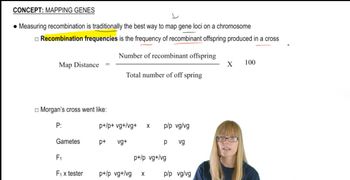
Mapping Genes

GFP (Green Fluorescent Protein)

GFP is a protein that exhibits bright green fluorescence when exposed to ultraviolet or blue light. It is derived from the jellyfish Aequorea victoria and is widely used as a reporter gene due to its ability to provide real-time visualization of gene expression in live cells and organisms. The advantages of GFP include its non-invasive nature and the ability to track dynamic processes in vivo, but it may have limitations in tissue penetration and photobleaching.
Recommended video:

lacZ Gene

The lacZ gene encodes the enzyme β-galactosidase, which can cleave specific substrates to produce a colorimetric change, making it useful for detecting gene expression. It is commonly used in various organisms, including bacteria and eukaryotes, but its application in multicellular organisms can be limited by the need for tissue fixation and the potential for background staining. While lacZ provides clear and quantifiable results, it lacks the real-time imaging capabilities that GFP offers.
Recommended video:
Guided course
09:09
Mapping Genes
Related Practice
Textbook Question

Go to the website http://www.cancer.gov and select 'Cancer Types' on the top menu bar. Scroll down to 'Breast Cancer' and click. Select 'Cases & Prevention' from the options. Click 'More information' and select 'BRCA Mutations: Cancer Risk and Genetic Testing'. Use the information on this page to answer the following questions. What are the approximate percentage increases in risk of having breast cancer and of having ovarian cancer for women inheriting harmful mutations of BRCA1 and BRCA2 compared with the risks in the general population?

466
views
Textbook Question

Go to the website http://www.cancer.gov and select 'Cancer Types' on the top menu bar. Scroll down to 'Breast Cancer' and click. Select 'Cases & Prevention' from the options. Click 'More information' and select 'BRCA Mutations: Cancer Risk and Genetic Testing'. Use the information on this page to answer the following questions. What features of family history increase the likelihood that a woman will have a harmful mutation of BRCA1 or BRCA2?

428
views
Textbook Question

The inheritance of certain mutations of BRCA1 can make it much more likely that a woman will develop breast or ovarian cancer in her lifetime. In addition to inheriting a BRCA1 mutation, what else must happen for a woman to develop breast or ovarian cancer?

385
views
Textbook Question

You conduct a study in which the transcriptional fusion of regulatory sequences of a particular gene with a reporter gene results in relatively uniform expression of the reporter gene in all cells of an organism. A translational fusion with the same gene shows reporter gene expression only in the nucleus of a specific cell type. Discuss some biological causes for the difference in expression patterns of the two transgenes.

512
views
Textbook Question

Discuss the similarities and differences between forward and reverse genetic approaches, and when you would choose to utilize each of the approaches.

779
views
Textbook Question

Using the data in Table B, calculate the average number of kilobase (kb) pairs per centimorgan in the six multicellular eukaryotic organisms. How would this information influence strategies to clone genes known only by a mutant phenotype in these organisms?

438
views