Discuss the advantages (and possible disadvantages) of the different approaches to reverse genetics.

Sanders 3rd Edition
Ch. 14 - Analysis of Gene Function via Forward Genetics and Reverse Genetics
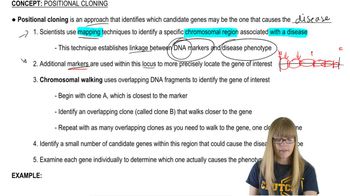
Problem 12You have identified a recessive mutation that alters bristle patterning in Drosophila and have used recombinant DNA technology to identify a genomic clone that you believe harbors the gene. How would you demonstrate that your gene is on the genomic clone?
Verified step by step guidance
Verified video answer for a similar problem:
Key Concepts
Recessive Mutation
Recombinant DNA Technology
Genomic Cloning
Discuss the advantages (and possible disadvantages) of the different mutagens in the following table:
You have identified a gene encoding the protein involved in the rate-limiting step in vitamin E biosynthesis. How would you create a transgenic plant producing large quantities of vitamin E in its seeds?
The CBF genes of Arabidopsis are induced by exposure of the plants to low temperature. How would you examine the temporal and spatial patterns of expression after induction by low temperature?
The CBF genes of Arabidopsis are induced by exposure of the plants to low temperature. Can you design a method that would reveal these changes in gene expression in a way that a farmer could recognize them by observing plants growing in the field?
When the S. cerevisiae genome was sequenced and surveyed for possible genes, only about 40% of those genes had been previously identified in forward genetic screens. This left about 60% of predicted genes with no known function, leading some to dub the genes fun (function unknown) genes. As an approach to understanding the function of a certain fun gene, you wish to create a loss-of-function allele. How will you accomplish this?