Pearson+ LogoPearson+ Logo
Ch. 15 - Recombinant DNA Technology and Its Applications
Sanders - Genetic Analysis: An Integrated Approach 3rd Edition
Sanders3rd EditionGenetic Analysis: An Integrated ApproachISBN: 9780135564172Not the one you use?Change textbook
Chapter 15, Problem E.4

What is the statistical principle underlying genetic health risk assessment? Why are these assessments not predictive of disease occurrence?

Verified step by step guidance
1
Understand that genetic health risk assessment is based on the principle of probability and statistics, which estimate the likelihood of developing a disease based on the presence of certain genetic variants in a population.
Recognize that these assessments use data from population studies, such as genome-wide association studies (GWAS), to calculate risk scores by comparing the frequency of genetic markers in affected versus unaffected individuals.
Note that the risk provided is a statistical probability, not a certainty, because it reflects increased or decreased chances rather than a definitive outcome for an individual.
Consider that genetic risk assessments do not account for environmental factors, lifestyle, gene-gene interactions, and epigenetic modifications, all of which can influence whether a disease actually develops.
Conclude that because of the complex interplay between genes and other factors, genetic health risk assessments are useful for estimating risk but cannot predict with certainty if or when a disease will occur.

Verified video answer for a similar problem:

This video solution was recommended by our tutors as helpful for the problem above.
Video duration:
2m
Was this helpful?

Key Concepts

Here are the essential concepts you must grasp in order to answer the question correctly.

Statistical Probability in Genetic Risk Assessment

Genetic health risk assessments use statistical probability to estimate the likelihood that an individual will develop a certain disease based on genetic variants. These probabilities are derived from population studies and reflect risk, not certainty, indicating how often a genetic variant is associated with disease occurrence.
Recommended video:

Multifactorial Nature of Disease

Most common diseases result from complex interactions between multiple genes and environmental factors. Because genetic variants are only one part of this interplay, genetic risk assessments cannot definitively predict disease but rather indicate increased or decreased risk.
Recommended video:
Guided course
05:54
Natural Selection

Penetrance and Expressivity

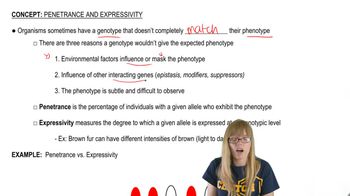
Penetrance refers to the proportion of individuals with a particular genetic variant who actually express the associated trait or disease, while expressivity describes the variability in symptoms. Incomplete penetrance and variable expressivity limit the predictive power of genetic risk assessments.
Recommended video:
Guided course
02:09
Penetrance and Expressivity
Related Practice
Textbook Question

What is CODIS? Describe the four most important features of genetic markers used in this system.

771
views
Textbook Question

Compare and contrast the terms Paternity Index (PI) and Combined Paternity Index (CPI). How does each contribute to paternity determination?

545
views
Textbook Question

What is the exclusion principle? How is it used in forensic genetic analysis and in paternity determination?

676
views
Textbook Question

Explain the meaning of 'identity by descent' in the context of identifying genealogical relationship between individuals. In these analyses, why are segments of chromosomes (haplotypes) rather than individual STRs used to identify genetic relationships?

665
views
Textbook Question

Figure E.1 illustrates the results of an electrophoretic analysis of 13 CODIS STR markers on a DNA sample and identifies the alleles for each gene. Table E.2 lists the frequencies for alleles of three of the STRs shown in the figure. Use this information to calculate the frequency of the genotype for STR genes FGA, vWA, and D3S1358 given in Figure E.1.

597
views
Textbook Question

Additional STR allele frequency information can be added to improve the analysis in Problem 8. The frequency of D8S1179₁₂ = 0.12. The frequency of D16S539₁₈ = 0.08 and of D16S539₂₀ = 0.21. Lastly, D18S51₁₉ = 0.13 and D18S51₂₀ = 0.10. Combine the allele frequency information for these three STR genes with the information used in Problem 8 to calculate the frequency of the genotype for six of the STR genes.

504
views