Pearson+ LogoPearson+ Logo
Ch. 17 - Organelle Inheritance and the Evolution of Organelle Genomes
Sanders - Genetic Analysis: An Integrated Approach 3rd Edition
Sanders3rd EditionGenetic Analysis: An Integrated ApproachISBN: 9780135564172Not the one you use?Change textbook
Chapter 17, Problem 8

Outline the steps required for a gene originally present in the endosymbiont genome to be transferred to the nuclear genome and be expressed, and for its product to be targeted back to the organelle of origin.

Verified step by step guidance
1
Identify the gene within the endosymbiont genome that is to be transferred to the nuclear genome.
The gene undergoes duplication, and one copy is transferred to the nuclear genome through a process such as horizontal gene transfer.
Once in the nuclear genome, the gene must acquire a promoter and other regulatory elements to be properly transcribed and expressed in the nucleus.
The gene product, typically a protein, must be synthesized in the cytoplasm and acquire a targeting signal, such as a transit peptide, that directs it back to the organelle of origin.
The protein is imported into the organelle through specific transport machinery, such as translocons, ensuring it reaches its functional location within the organelle.

Verified video answer for a similar problem:

This video solution was recommended by our tutors as helpful for the problem above.
Video duration:
2m
Was this helpful?

Key Concepts

Here are the essential concepts you must grasp in order to answer the question correctly.

Endosymbiotic Theory

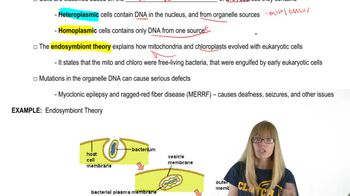
The endosymbiotic theory posits that certain organelles, such as mitochondria and chloroplasts, originated from free-living prokaryotes that were engulfed by ancestral eukaryotic cells. This theory explains the presence of their own DNA, which is distinct from nuclear DNA, and suggests a complex evolutionary relationship between these organelles and their host cells.
Recommended video:
Guided course
04:11
Organelle DNA Characteristics

Gene Transfer Mechanisms

Gene transfer from the endosymbiont genome to the nuclear genome involves several mechanisms, including horizontal gene transfer and the integration of endosymbiont DNA into the nuclear genome. This process typically requires the DNA to be transcribed and translated in the nucleus, followed by the transport of the resulting protein back to the organelle, often involving specific targeting signals.
Recommended video:
Guided course
09:09
Mapping Genes

Protein Targeting and Import

Once a gene product is synthesized in the cytoplasm, it must be correctly targeted to the organelle of origin. This process involves signal peptides that direct the protein to the appropriate organelle, where it is imported through specialized translocons. Proper folding and post-translational modifications may also occur to ensure the protein functions correctly within the organelle.
Recommended video:
Related Practice
Textbook Question

Draw a graph depicting the relative amounts of nuclear DNA present in the different stages of the cell cycle (G₁,S,G₂,M). On the same graph, plot the amount of mitochondrial DNA present at each stage of the cell cycle.

469
views
Textbook Question

What are the differences between the universal code and that found in the mitochondria of some species? Given that some changes (UGA =stop→Trp) have occurred multiple independent times in evolution, can you think of any selective advantage to the mitochondrial code?

789
views
Textbook Question

What is the evidence that the ancient mitochondrial and chloroplast endosymbionts are related to the alphaproteobacteria and cyanobacteria, respectively?

552
views
Textbook Question

Consider the phylogenetic tree presented in the following figure (Figure 17.17). How were the origins of secondary endosymbiosis in the brown algae determined?

573
views
Textbook Question

You are a genetic counselor, and several members of the family whose pedigree for an inherited disorder is depicted in Genetic Analysis 17.2 consult with you about the probability that their progeny may be afflicted. What advice would you give individuals III-1, III-2, III-4, III-6, III-8, and III-9?

835
views
Textbook Question

A mutation in Arabidopsis immutans results in the necrosis (death) of tissues in a mosaic configuration. Examination of the mitochondrial DNA detects deletions of various regions of the mitochondrial genome in the tissues that are necrotic. When immutans plants are crossed with wild-type plants, the  are wild type, and the  are wild type and immutans in a 3:1 ratio. Explain the inheritance of the immutans mutation and a possible origin of the mitochondrial DNA deletions.

458
views