Pearson+ LogoPearson+ Logo
Ch. 18 - Developmental Genetics
Sanders - Genetic Analysis: An Integrated Approach 3rd Edition
Sanders3rd EditionGenetic Analysis: An Integrated ApproachISBN: 9780135564172Not the one you use?Change textbook
Chapter 18, Problem 5c

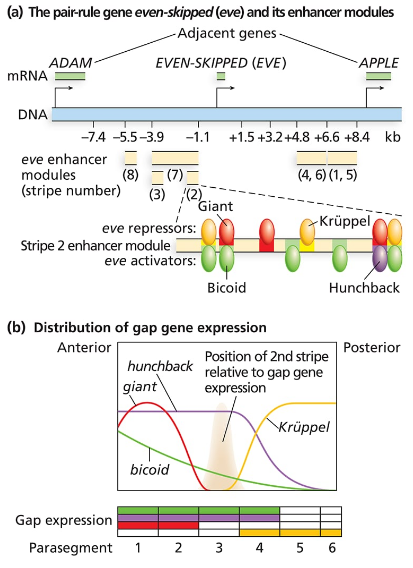
Consider the even-skipped regulatory sequences in Figure 18.9.
Explain what you expect to see happen to even-skipped stripe 2 if it is expressed in a Krüppel mutant background. What about a hunchback mutant background? A giant mutant background? A bicoid mutant background?
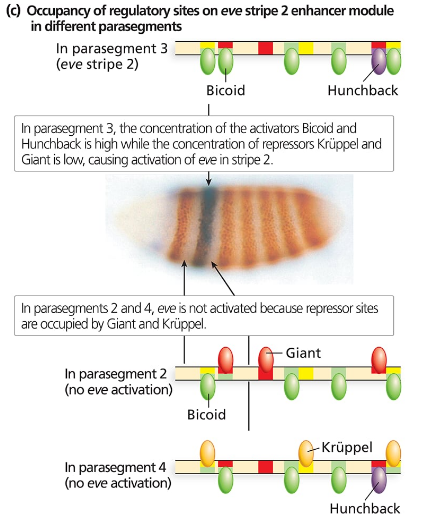
Diagram showing even-skipped gene enhancers, repressors, activators, and gap gene expression patterns across embryo segments.Diagram showing regulatory protein binding on eve stripe 2 enhancer and resulting stripe expression in different mutant backgrounds.

Verified step by step guidance
1
Step 1: Understand the role of the even-skipped (eve) gene and its stripe 2 expression pattern. The eve gene is expressed in seven stripes during Drosophila embryogenesis, and stripe 2 expression is regulated by a combination of activators and repressors binding to its regulatory sequences.
Step 2: Identify the regulatory proteins involved in controlling eve stripe 2. Key regulators include Bicoid and Hunchback as activators, and Giant and Krüppel as repressors. Each protein binds to specific sites in the stripe 2 enhancer to shape the stripe's position and intensity.
Step 3: Predict the effect of a Krüppel mutant background. Since Krüppel normally represses eve expression outside stripe 2 boundaries, its absence would likely cause the stripe 2 expression domain to expand into regions where Krüppel repression is lost.
Step 4: Predict the effect of a Hunchback mutant background. Hunchback acts as an activator for stripe 2, so in its absence, the activation of eve stripe 2 would be reduced or lost, leading to diminished or absent stripe 2 expression.
Step 5: Predict the effects of Giant and Bicoid mutant backgrounds. Giant represses eve expression flanking stripe 2, so a giant mutant would cause expansion of stripe 2 expression. Bicoid is an activator required for stripe 2 initiation, so a bicoid mutant would result in loss or severe reduction of stripe 2 expression.

Verified video answer for a similar problem:

This video solution was recommended by our tutors as helpful for the problem above.
Video duration:
3m
Was this helpful?

Key Concepts

Here are the essential concepts you must grasp in order to answer the question correctly.

Even-skipped (eve) Stripe 2 Regulation

The even-skipped gene is expressed in seven stripes during Drosophila embryogenesis, with stripe 2 regulated by a specific enhancer integrating inputs from multiple transcription factors. This stripe's precise spatial expression depends on activators and repressors binding to its regulatory sequences, making it a model for understanding gene regulation in development.
Recommended video:
Guided course
03:51
GAL Regulation

Role of Maternal and Gap Genes in Pattern Formation

Maternal effect genes like bicoid establish initial gradients that activate gap genes such as hunchback, Krüppel, and giant. These gap genes encode transcription factors that define broad embryonic regions and regulate pair-rule genes like even-skipped, shaping the segmented body plan by activating or repressing specific stripes.
Recommended video:
Guided course
11:19
Segmentation Genes

Effects of Mutations in Gap Genes on eve Stripe 2 Expression

Mutations in gap genes alter the balance of activators and repressors controlling eve stripe 2. For example, a Krüppel mutant may reduce repression, expanding stripe 2; a hunchback mutant may reduce activation, diminishing stripe 2; a giant mutant may affect repression boundaries; and a bicoid mutant disrupts initial activation, often abolishing stripe 2 expression.
Recommended video:
Guided course
03:38
Maternal Effect
Related Practice
Textbook Question

Early development in Drosophila is atypical in that pattern formation takes place in a syncytial blastoderm, allowing free diffusion of transcription factors between nuclei. In many other animal species, the fertilized egg is divided by cellular cleavages into a larger and larger number of smaller and smaller cells.

How must the model that describes Drosophila development be modified for describing animal species whose early development is not syncytial?

552
views
Textbook Question

Consider the even-skipped regulatory sequences in the following figure:

How are the sharp boundaries of expression of Eve Stripe 2 formed?

468
views
Textbook Question

Consider the even-skipped regulatory sequences in Figure 18.9.

Consider the binding sites for gap proteins and Bicoid in the stripe 2 enhancer module. What sites are occupied in parasegments 2, 3, and 4, and how does this result in expression or no expression?

553
views
Textbook Question

What is the difference between a parasegment and a segment in Drosophila development? Why do developmental biologists think of parasegments as the subdivisions that are produced during the development of flies?

1249
views
Textbook Question

Why do loss-of-function mutations in Hox genes usually result in embryo lethality, whereas gain-of-function mutants can be viable? Why are flies homozygous for the recessive loss-of-function alleles  and  viable?

495
views
Textbook Question

Compare and contrast the specification of segmental identity in Drosophila with that of floral organ specification in Arabidopsis. What is the same in this process, and what is different?

558
views