Pearson+ LogoPearson+ Logo
Ch. 18 - Developmental Genetics
Sanders - Genetic Analysis: An Integrated Approach 3rd Edition
Sanders3rd EditionGenetic Analysis: An Integrated ApproachISBN: 9780135564172Not the one you use?Change textbook
Chapter 18, Problem 4a

Early development in Drosophila is atypical in that pattern formation takes place in a syncytial blastoderm, allowing free diffusion of transcription factors between nuclei. In many other animal species, the fertilized egg is divided by cellular cleavages into a larger and larger number of smaller and smaller cells.
What constraints does the formation of a syncytial blastoderm impose on the mechanisms of pattern formation?

Verified step by step guidance
1
Understand the concept of a syncytial blastoderm: In Drosophila, early development involves a syncytial blastoderm, where nuclei divide without forming individual cells. This allows transcription factors to diffuse freely between nuclei, unlike in species where cellular cleavages create distinct cells early on.
Identify the role of transcription factors: Transcription factors are proteins that regulate gene expression by binding to specific DNA sequences. In a syncytial blastoderm, these factors can move freely, influencing multiple nuclei simultaneously, which is different from species with cellularized embryos where diffusion is restricted.
Consider the constraints on spatial patterning: Since transcription factors can diffuse freely in a syncytial blastoderm, the mechanisms of pattern formation must rely on gradients of these factors. This means that precise spatial gradients of transcription factors are critical for establishing distinct regions of gene expression.
Analyze the importance of gradient stability: The formation of a syncytial blastoderm imposes the constraint that gradients of transcription factors must be stable and robust to ensure proper patterning. Any disruption in the gradient could lead to widespread errors in development, as multiple nuclei are exposed to the same environment.
Compare with cellularized embryos: In species with early cellularization, transcription factors are confined within individual cells, allowing for localized control of gene expression. In contrast, the syncytial blastoderm requires mechanisms that coordinate gene expression across a shared cytoplasm, making the establishment and maintenance of gradients more critical.

Verified video answer for a similar problem:

This video solution was recommended by our tutors as helpful for the problem above.
Video duration:
2m
Was this helpful?

Key Concepts

Here are the essential concepts you must grasp in order to answer the question correctly.

Syncytial Blastoderm

A syncytial blastoderm is a stage in early embryonic development where multiple nuclei share a common cytoplasm without cell membranes separating them. This structure allows for the free diffusion of molecules, including transcription factors, which can influence gene expression across the entire embryo. In Drosophila, this unique arrangement facilitates rapid and coordinated pattern formation, as signaling molecules can easily move between nuclei.
Recommended video:
Guided course
03:46
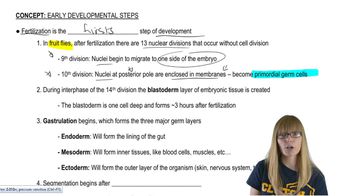
Drosophilia Development

Transcription Factors

Transcription factors are proteins that bind to specific DNA sequences to regulate the transcription of genes. In the context of a syncytial blastoderm, the ability of transcription factors to diffuse freely between nuclei allows for a more dynamic and responsive patterning process. This can lead to the simultaneous activation or repression of genes across multiple nuclei, which is crucial for establishing the body plan and segmentation in the developing embryo.
Recommended video:
Guided course
09:16
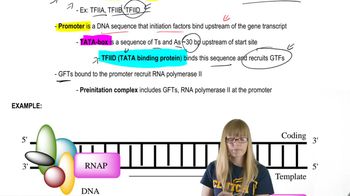
Eukaryotic Transcription

Pattern Formation

Pattern formation refers to the process by which cells in an embryo acquire different identities and organize into structured tissues and organs. In a syncytial blastoderm, the constraints of having a shared cytoplasm mean that pattern formation relies heavily on gradients of signaling molecules and transcription factors. This can lead to more uniform responses across the embryo, but may also limit the complexity of spatially distinct patterns that can be achieved compared to organisms with individual cell boundaries.
Recommended video:
Guided course
04:06
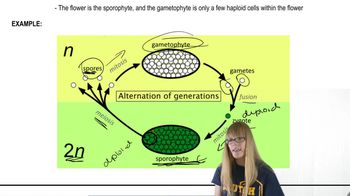
Formation of Plant Gametes
Related Practice
Textbook Question

Explain why many developmental genes encode either transcription factors or signaling molecules.

565
views
Textbook Question

Bird beaks develop from an embryonic group of cells called neural crest cells that are part of the neural tube, which gives rise to the spinal column and related structures. Amazingly, neural crest cells can be surgically transplanted from one embryo to another, even between embryos of different species. When quail neural crest cells were transplanted into duck embryos, the beak of the host embryo developed into a shape similar to that found in quails, creating the 'quck.' Duck cells were recruited in addition to the quail cells to form part of the quck beak. Conversely, when duck neural crest cells were transplanted into quail embryos, the beak of the embryo resembled that of a duck, creating a 'duail,' and quail cells were recruited to form part of the beak. What do these experiments tell you about the autonomy or nonautonomy of the transplanted and host cells during beak development?

426
views
Textbook Question

How is positional information provided along the anterior–posterior axis in Drosophila? What are the functions of bicoid and nanos?

511
views
Textbook Question

Early development in Drosophila is atypical in that pattern formation takes place in a syncytial blastoderm, allowing free diffusion of transcription factors between nuclei. In many other animal species, the fertilized egg is divided by cellular cleavages into a larger and larger number of smaller and smaller cells.

How must the model that describes Drosophila development be modified for describing animal species whose early development is not syncytial?

552
views
Textbook Question

Consider the even-skipped regulatory sequences in the following figure:

How are the sharp boundaries of expression of Eve Stripe 2 formed?

468
views
Textbook Question

Consider the even-skipped regulatory sequences in Figure 18.9.

Consider the binding sites for gap proteins and Bicoid in the stripe 2 enhancer module. What sites are occupied in parasegments 2, 3, and 4, and how does this result in expression or no expression?

553
views