Three-spined stickleback fish live in lakes formed when the last ice age ended 10,000 to 15,000 years ago. In lakes where the sticklebacks are prey for larger fish, they develop 35 bony plates along their body as armor. In contrast, sticklebacks in lakes where there are no predators develop only a few or no bony plates. Loss-of-function mutations in the coding region of the homologous gene in humans result in loss of hair, teeth, and sweat glands, as in the toothless men of Sind (India). What does this suggest about hair, teeth, and sweat glands in humans?

Homeotic genes are thought to regulate each other. Are similar interactions observed between Hox genes?
Verified step by step guidance
Verified video answer for a similar problem:
Key Concepts
Homeotic Genes
Hox Genes
Gene Regulation
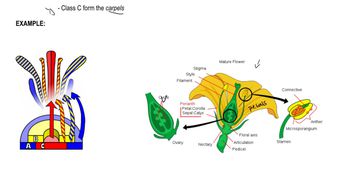
The flowering jungle plant Lacandonia schismatica, discovered in southern Mexico, has a unique floral structure. Petal-like organs are in the outer whorls surrounding a number of carpels, and stamens are in the center of the flower. Closely related species are dioecious; female plants bear flowers that resemble those of Lacandonia, but without the central stamens. What type of mutation could have resulted in the evolution of Lacandonia flowers?
Homeotic genes are thought to regulate each other. What aspect of the phenotype of apetala2 agamous double mutants indicates that these two genes act antagonistically?
Dipterans (two-winged insects) are thought to have evolved from a four-winged ancestor that had wings on both T2 and T3 thoracic segments, as in extant butterflies and dragonflies. Describe an evolutionary scenario for the evolution of dipterans from four-winged ancestors. What types of mutations could lead to a butterfly developing with only two wings?
Basidiomycota is a monophyletic group of fungi that includes most of the common mushrooms. You are interested in the development of the body plan of mushrooms. How would you identify the genes required for patterning during mushroom development?
Zea mays (maize, or corn) was originally domesticated in central Mexico at least 7000 years ago from an endemic grass called teosinte. Teosinte is generally unbranched, has male and female flowers on the same branch, and has few kernels per 'cob,' each encased in a hard, leaf-like organ called a glume. In contrast, maize is highly branched, with a male inflorescence (tassel) on its central branch and female inflorescences (cobs) on axillary branches. In addition, maize cobs have many rows of kernels and soft glumes. George Beadle crossed cultivated maize and wild teosinte, which resulted in fully fertile F₁ plants. When the F₁ plants were self-fertilized, about 1 plant in every 1000 of the F₂ progeny resembled either a modern maize plant or a wild teosinte plant. What did Beadle conclude about whether the different architectures of maize and teosinte were caused by changes with a small effect in many genes or changes with a large effect in just a few genes?
