Pearson+ LogoPearson+ Logo
Ch. 19 - Genetic Analysis of Quantitative Traits
Sanders - Genetic Analysis: An Integrated Approach 3rd Edition
Sanders3rd EditionGenetic Analysis: An Integrated ApproachISBN: 9780135564172Not the one you use?Change textbook
Chapter 19, Problem 3

Compare and contrast broad sense heritability and narrow sense heritability, giving an example of each measurement and identifying how the measurement is used.

Verified step by step guidance
1
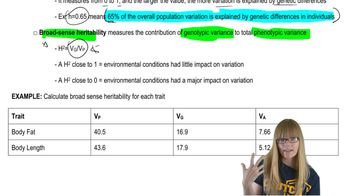
Broad sense heritability (H²) measures the proportion of phenotypic variance in a population that is attributable to all genetic variance, including additive, dominance, and epistatic effects. Narrow sense heritability (h²), on the other hand, measures the proportion of phenotypic variance that is due specifically to additive genetic variance, which is the component passed from parents to offspring.
To calculate broad sense heritability (H²), use the formula: H²=VGVP, where VG is the total genetic variance and VP is the total phenotypic variance.
To calculate narrow sense heritability (h²), use the formula: h²=VAVP, where VA is the additive genetic variance and VP is the total phenotypic variance.
An example of broad sense heritability is studying the genetic contribution to height in a population, where dominance and epistatic effects are included. This measurement is used to understand the overall genetic influence on a trait.
An example of narrow sense heritability is estimating the heritability of milk production in dairy cattle, focusing on additive genetic variance. This measurement is used in selective breeding programs to predict the response to selection.

Verified video answer for a similar problem:

This video solution was recommended by our tutors as helpful for the problem above.
Video duration:
3m
Was this helpful?

Key Concepts

Here are the essential concepts you must grasp in order to answer the question correctly.

Broad Sense Heritability

Broad sense heritability (H²) measures the proportion of phenotypic variance in a trait that can be attributed to genetic variance, including additive, dominance, and interaction effects among alleles. It provides a comprehensive view of genetic influence on traits, but does not distinguish between different types of genetic contributions. For example, in a study of plant height, broad sense heritability would consider all genetic factors affecting height, making it useful for understanding overall genetic potential.
Recommended video:
Guided course
07:04
Calculating Heritability

Narrow Sense Heritability

Narrow sense heritability (h²) focuses specifically on the proportion of phenotypic variance that is due to additive genetic variance alone. This measurement is crucial for predicting the response to selection in breeding programs, as it reflects the heritable traits that can be passed on to the next generation. For instance, in livestock breeding, narrow sense heritability would be used to estimate how much of the variation in milk production is due to additive genetic factors, guiding selection decisions.
Recommended video:
Guided course
07:04
Calculating Heritability

Applications in Genetics

Both broad and narrow sense heritability are essential in genetics for understanding trait inheritance and guiding breeding strategies. Broad sense heritability helps researchers assess the overall genetic contribution to traits, while narrow sense heritability is more applicable in predicting the outcomes of selective breeding. For example, in agriculture, knowing the narrow sense heritability of crop yield can inform farmers on which plants to select for future planting to enhance yield.
Recommended video:
Guided course
03:45
Descriptive Genetics