

Cattle breeders would like to improve the protein content and butterfat content of milk produced by a herd of cows. Narrow sense heritability values are 0.60 for protein content and 0.80 for butterfat content. The average percentages of these traits in the herd and the percentages of the traits in cows selected for breeding are as follows. Trait Herd Average Selected Cows Protein content 20.2% 22.7% Butterfat content 6.5% 7.4% Which trait is likely to be the most responsive to artificial selection applied by the cattle breeders through selection of cows for mating?

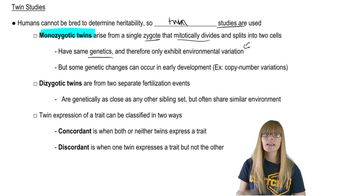
The children of couples in which one partner has blood type O (genotype ii) and the other partner has blood type AB (genotype IᴬIᴮ) are studied. What is the expected concordance rate for blood type of MZ twins in this study? Explain your answer.
Verified step by step guidance
Verified video answer for a similar problem:
Key Concepts
Blood Type Inheritance
Monozygotic (MZ) Twins
Concordance Rate
In human gestational development, abnormalities of the closure of the lower part of the mid-face can result in cleft lip, if the lip alone is affected by the closure defect, or in cleft lip and palate (the roof of the mouth), if the closure defect is more extensive. Cleft lip and cleft lip with cleft palate are multifactorial disorders that are threshold traits. A family with a history of either condition has a significantly increased chance of a recurrence of mid-face cleft disorder in comparison with families without such a history. However, the recurrence risk of a mid-face cleft disorder is higher in families with a history of cleft lip with cleft palate than in families with a history of cleft lip alone. Suppose a friend of yours who has not taken genetics asks you to explain these observations. Construct a genetic explanation for the increased recurrence risk of mid-face clefting in families that have a history of cleft disorders versus families without a history of such disorders.
In human gestational development, abnormalities of the closure of the lower part of the mid-face can result in cleft lip, if the lip alone is affected by the closure defect, or in cleft lip and palate (the roof of the mouth), if the closure defect is more extensive. Cleft lip and cleft lip with cleft palate are multifactorial disorders that are threshold traits. A family with a history of either condition has a significantly increased chance of a recurrence of mid-face cleft disorder in comparison with families without such a history. However, the recurrence risk of a mid-face cleft disorder is higher in families with a history of cleft lip with cleft palate than in families with a history of cleft lip alone. Construct a similar explanation of why the recurrence risk of a cleft disorder is higher in families with a history of cleft lip with cleft palate than in families with a history of cleft lip alone.
The children of couples in which one partner has blood type O (genotype ii) and the other partner has blood type AB (genotype IᴬIᴮ) are studied. What is the expected concordance rate for blood type of DZ twins in this study? Explain why this answer is different from the answer to part (a).
Answer the following in regard to multifactorial traits in human twins. If the trait is substantially influenced by genes, would you expect the concordance rate to be higher in MZ twins or higher in DZ twins? Explain your reasoning.
Answer the following in regard to multifactorial traits in human twins. If the trait is produced with little contribution from genetic variation, what would you expect to see if you compared the concordance rates of MZ twins versus DZ twins? Explain your reasoning.
