Pearson+ LogoPearson+ Logo
Ch. 19 - Genetic Analysis of Quantitative Traits
Sanders - Genetic Analysis: An Integrated Approach 3rd Edition
Sanders3rd EditionGenetic Analysis: An Integrated ApproachISBN: 9780135564172Not the one you use?Change textbook
Chapter 19, Problem 25b

In human gestational development, abnormalities of the closure of the lower part of the mid-face can result in cleft lip, if the lip alone is affected by the closure defect, or in cleft lip and palate (the roof of the mouth), if the closure defect is more extensive. Cleft lip and cleft lip with cleft palate are multifactorial disorders that are threshold traits. A family with a history of either condition has a significantly increased chance of a recurrence of mid-face cleft disorder in comparison with families without such a history. However, the recurrence risk of a mid-face cleft disorder is higher in families with a history of cleft lip with cleft palate than in families with a history of cleft lip alone. Construct a similar explanation of why the recurrence risk of a cleft disorder is higher in families with a history of cleft lip with cleft palate than in families with a history of cleft lip alone.

Verified step by step guidance
1
Understand the concept of multifactorial inheritance: Multifactorial disorders are influenced by multiple genetic and environmental factors. Threshold traits occur when the combined effect of these factors surpasses a certain threshold, leading to the manifestation of the disorder.
Recognize the genetic contribution: Cleft lip with cleft palate involves a more extensive closure defect, which likely indicates a higher genetic load (more contributing alleles or genetic variants) compared to cleft lip alone. This higher genetic load increases the likelihood of recurrence in families.
Consider environmental factors: Environmental influences also play a role in multifactorial disorders. Families with a history of cleft lip with cleft palate may share environmental factors that contribute to the recurrence risk, alongside genetic predisposition.
Analyze the threshold model: In the threshold model, cleft lip with cleft palate may represent a condition that requires a higher accumulation of risk factors (both genetic and environmental) to surpass the threshold. Families with this history are more likely to have individuals who inherit a combination of factors that exceed the threshold.
Summarize the recurrence risk: The recurrence risk is higher in families with a history of cleft lip with cleft palate because the genetic and environmental factors contributing to the disorder are more extensive, increasing the probability that these factors will be passed on to offspring and lead to the disorder.

Verified video answer for a similar problem:

This video solution was recommended by our tutors as helpful for the problem above.
Video duration:
2m
Was this helpful?

Key Concepts

Here are the essential concepts you must grasp in order to answer the question correctly.

Multifactorial Inheritance

Multifactorial inheritance refers to traits that are influenced by multiple genes and environmental factors. Conditions like cleft lip and palate arise from the interaction of genetic predispositions and external influences, making them complex to predict. This model explains why certain families may have a higher recurrence risk based on their genetic background and environmental exposures.
Recommended video:
Guided course
05:13
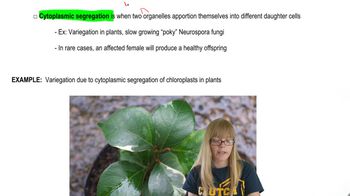
Organelle Inheritance

Threshold Traits

Threshold traits are characteristics that do not manifest until a certain genetic and environmental threshold is crossed. In the case of cleft disorders, individuals may carry risk alleles that do not lead to the condition unless combined with specific environmental factors. This concept helps explain why some families with a history of cleft lip with cleft palate have a higher recurrence risk, as they may have a greater genetic load that pushes them over the threshold.
Recommended video:
Guided course
13:40
Traits and Variance

Familial Aggregation

Familial aggregation refers to the increased likelihood of a trait or disorder occurring in relatives compared to the general population. In the context of cleft disorders, families with a history of cleft lip with cleft palate show a higher recurrence risk due to shared genetic factors and environmental influences. This concept underscores the importance of family history in assessing the risk of cleft disorders in future generations.
Recommended video:
Guided course
03:46
Drosophilia Development
Related Practice
Textbook Question

Cattle breeders would like to improve the protein content and butterfat content of milk produced by a herd of cows. Narrow sense heritability values are 0.60 for protein content and 0.80 for butterfat content. The average percentages of these traits in the herd and the percentages of the traits in cows selected for breeding are as follows. Trait Herd Average Selected Cows Protein content 20.2% 22.7% Butterfat content  6.5%  7.4% Determine the selection differential (S) for each trait in this herd.

452
views
Textbook Question

Cattle breeders would like to improve the protein content and butterfat content of milk produced by a herd of cows. Narrow sense heritability values are 0.60 for protein content and 0.80 for butterfat content. The average percentages of these traits in the herd and the percentages of the traits in cows selected for breeding are as follows. Trait Herd Average Selected Cows Protein content 20.2% 22.7% Butterfat content  6.5%  7.4% Which trait is likely to be the most responsive to artificial selection applied by the cattle breeders through selection of cows for mating?

373
views
Textbook Question

In human gestational development, abnormalities of the closure of the lower part of the mid-face can result in cleft lip, if the lip alone is affected by the closure defect, or in cleft lip and palate (the roof of the mouth), if the closure defect is more extensive. Cleft lip and cleft lip with cleft palate are multifactorial disorders that are threshold traits. A family with a history of either condition has a significantly increased chance of a recurrence of mid-face cleft disorder in comparison with families without such a history. However, the recurrence risk of a mid-face cleft disorder is higher in families with a history of cleft lip with cleft palate than in families with a history of cleft lip alone. Suppose a friend of yours who has not taken genetics asks you to explain these observations. Construct a genetic explanation for the increased recurrence risk of mid-face clefting in families that have a history of cleft disorders versus families without a history of such disorders.

434
views
Textbook Question

The children of couples in which one partner has blood type O (genotype ii) and the other partner has blood type AB (genotype IᴬIᴮ) are studied. What is the expected concordance rate for blood type of MZ twins in this study? Explain your answer.

435
views
Textbook Question

The children of couples in which one partner has blood type O (genotype ii) and the other partner has blood type AB (genotype IᴬIᴮ) are studied. What is the expected concordance rate for blood type of DZ twins in this study? Explain why this answer is different from the answer to part (a).

365
views
Textbook Question

Answer the following in regard to multifactorial traits in human twins. If the trait is substantially influenced by genes, would you expect the concordance rate to be higher in MZ twins or higher in DZ twins? Explain your reasoning.

361
views